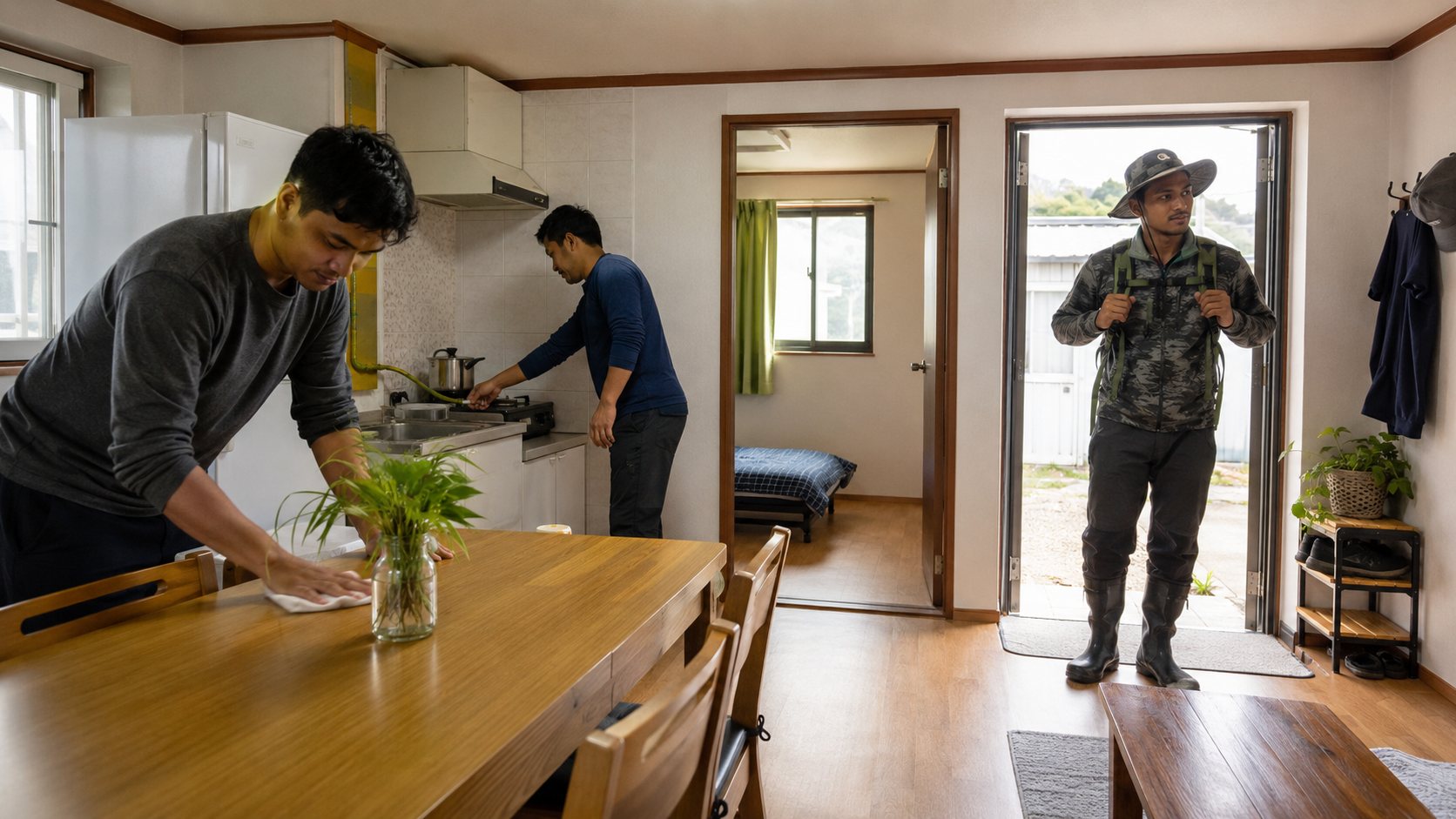
When living as a seasonal worker in Korea, there are many cases where several people share the same accommodation. Because of different lifestyles and languages, even small issues can lead to conflict, but setting ground rules on the first day of moving in can prevent most inconveniences.
Especially when you go out to work, you should check lights, air conditioners, electric heaters, and gas valves. However, turning off the boiler in winter can cause it to freeze and burst, so portable heaters and boilers must be managed separately.
In this article, I explain the cleaning, noise, electricity, heating, cooling, kitchen, and trash disposal rules for shared accommodations, as well as how I actually check them before going out.
Table of Contents
- Living rules to be established on the first day of moving in
- Cleaning personal and public spaces
- How to use shared accommodation electrical appliances
- Things you must check before going to work
- How to actually check before leaving the accommodation
- How to use air conditioners and heating facilities
- Safety rules for kitchen and gas facilities
- Refrigerator, food ingredients, and waste management
- Rules for using the washing machine and restroom
- Noise, personal items, and visitor management
- How to deal with emergency situations such as fire, crime, etc.
- Check living expenses and shared rates
- How to resolve conflicts when they arise
Set your living rules together on the first day you move in.
When moving into shared accommodation, it is a good idea to check the basic rules with the people you live with rather than waiting for someone to set the rules first.
Items to check on the first day of moving in
- Person responsible for cleaning common areas and cleaning date
- Time to be quiet at night
- Washing machine usable time
- Refrigerator private compartment and public compartment
- Discharge location and date for each type of waste
- How to purchase common items such as toilet paper, detergent, cooking oil, etc.
- How to pay electricity, water, and gas bills
- Management of entrance keys and passwords
- External visitor access rules
- Evacuation route in case of fire
- Contact information for employer, manager, and interpreter
Rather than unilaterally set by one person, it is better to explain and agree on rules in a language that everyone who uses them can understand. If you write down the decision on paper and stick it on the refrigerator or next to the door, new residents can easily check it.
Even if the dormitory is provided by the employer, the privacy of workers must not be violated beyond what is necessary for safety and communal living. The relevant basic principles are [National Legislation Information Center Labor Standards ActYou can check it here.
Clean private and public spaces separately
In shared accommodation, it is difficult to keep the entire accommodation clean by cleaning only your own bedroom. It is effective to set a cleaning duty for spaces that everyone uses, such as the kitchen, bathroom, and living room.
Personal space management
- Do not leave bedding and clothes piled on the floor for long periods of time.
- Do not leave wet clothes and towels in the bedroom.
- Do not store food in the bedroom for long periods of time
- Separate and dispose of personal waste yourself.
- Open windows and ventilate regularly
- If mold, pests, or water leaks are discovered, notify the manager immediately.
Common space management
- Clean up the kitchen immediately after cooking
- Removing food from the sink drain
- Prevent water from accumulating on the bathroom floor
- Remove hair and soap scum
- Empty public trash cans before they are full
- When cleaning is finished, mark on the duty sheet.
When using cleaning detergents, you must open a window for ventilation. In particular, you should never mix bleach, acidic detergents, or ammonia-based detergents as this may generate dangerous gases.
Use electrical appliances safely in shared accommodation
In shared accommodation, multiple people share cell phone chargers, rice cookers, microwave ovens, air conditioners, and heaters, which can result in excessive power concentration in the outlets.
Things to keep in mind when using electrical appliances
- Do not touch plugs or outlets with wet hands
- Do not connect many products to one power strip
- Do not connect other power strips to a power strip in succession.
- Electric heaters and electric stoves should be connected to wall outlets if possible. Connect directly
- Unplug the charged cell phone and auxiliary battery
- Do not fold the electric blanket or press it with heavy objects.
- Do not use products with peeled or pressed wires
- If there is a burning smell or heat coming from the outlet, stop using it immediately.
- Do not disassemble broken electrical appliances yourself.
- Do not add large electrical appliances without administrator permission
The government's life safety guidelines also recommend avoiding using octopus-type power strips and unplugging electric appliances that are not in use. For more information [Republic of Korea Policy Briefing Electrical and Fire Safety RulesYou can check it here.
Be sure to check before going to work
If lights, air conditioners, and heating appliances continue to operate when no one is home, not only will your electricity bills increase, but the risk of fire may also increase.
If several people go to work together, it is a good idea to designate the last person to leave as the ‘final checker.’
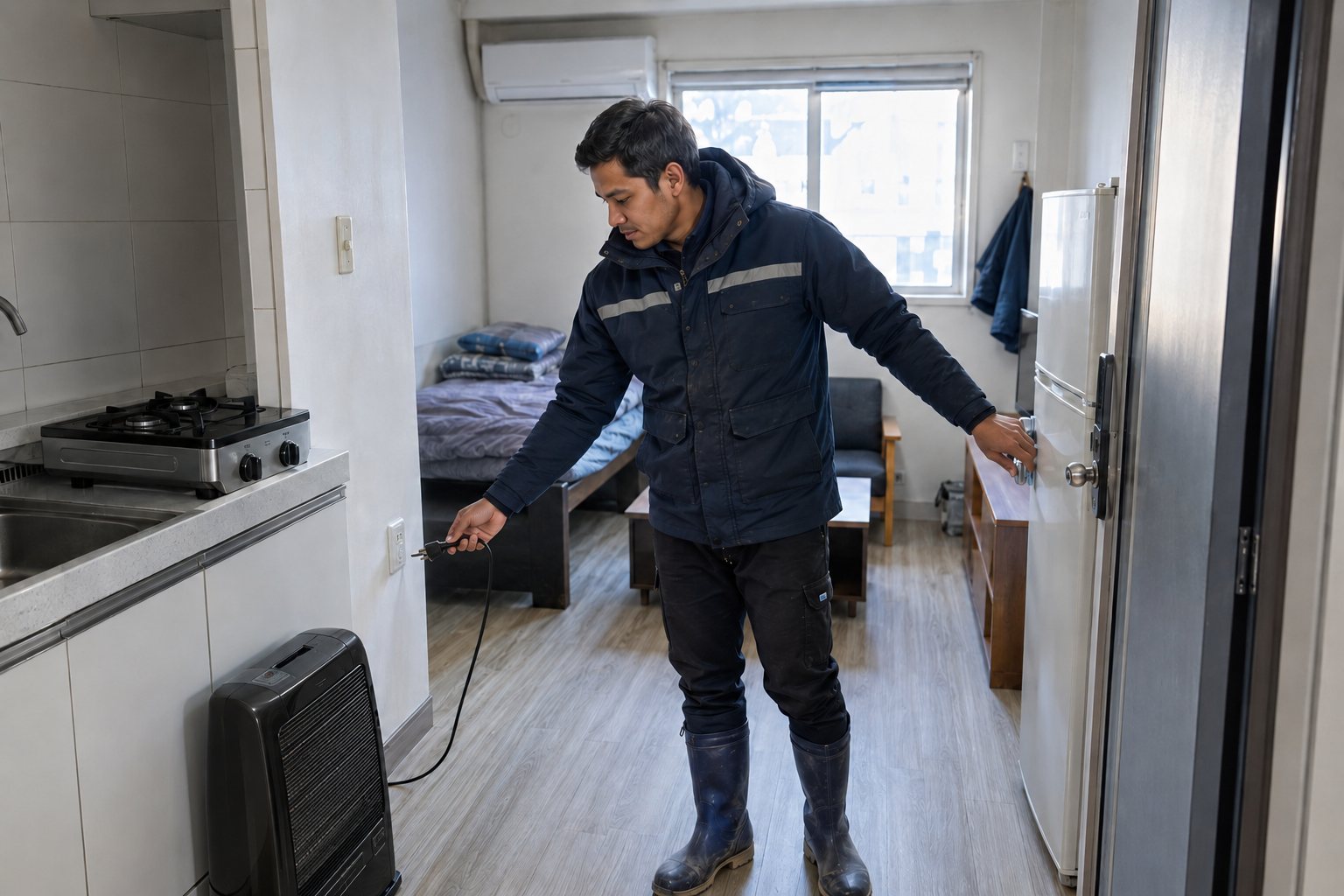
Verification target · How to check before going to work
- lighting · Turn off lights in bedroom, bathroom, kitchen, and living room
- air conditioner · Power off, close windows
- Fan·TV · Check if the power is off
- Electric heater/electric stove · Turn off the power and unplug if possible
- Electric blanket/heating mat · Turn off and unplug
- rice cooker · Check whether you need to keep warm when going out for a long time
- gas range · Make sure the light is off and close the gas valve
- Cell phone charger · When charging is complete, unplug
- Capital · Check if faucets and showers are turned off
- windows · Close and lock after checking the weather and ventilation conditions
- Entrance door · Check if the last person locked the door
- Refrigerator · Keeping Power on for Food Storage
- boiler · Setting to away mode or lower temperature depending on season and equipment
Do not turn off any equipment that must continue to operate, such as refrigerators or smoke detectors. Boilers also have a risk of freezing and bursting in the winter, so you should check the type and the manager's instructions.
How to actually check before leaving the accommodation
When I actually go out to work or go out for a long time, I take a look around the inside of the accommodation before opening the front door.
First, turn off the lights in the bedroom and living room and make sure the air conditioner or fan is not running. If you used an electric blanket or portable heater, not only press the power button, but also unplug it.
Then, go to the kitchen, check that the gas stove light is off, and close the gas valve. Also check that water is not flowing from the faucet. Lastly, check the windows and front door before leaving the accommodation.
I use the method of briefly recalling the following five things at the front door:
“Fire, air conditioner, heater, gas, door.”
If you make this order a habit, you will reduce the number of items you miss even during busy commute times. When several people go out together, letting them know “I checked last time” will reduce the inconvenience of having to go back to the accommodation to check.
However, in winter, the boiler power is not turned off unconditionally. Turn off the portable electric heater and electric blanket, but set the boiler to away mode or low temperature according to the accommodation manager's instructions. The refrigerator is also kept on to store food.
Use air conditioners and heating facilities according to their type.
Air conditioner usage rules
- Close windows and doors when using the air conditioner
- Do not use for long periods of time at excessively low temperatures
- Turn off the power when no one is in the accommodation
- Notify the administrator if water leaks or makes strange noises
- Do not stack objects on top of the air conditioner or around the outdoor unit.
- If the filter needs to be cleaned, check with the administrator on how to do so.
Because everyone has different desired temperatures, it is best to agree on the air conditioner temperature and usage time. great. If one person continues to change the temperature arbitrarily, electricity bills and daily life conflicts may increase.
Rules for using portable heaters
Electric heaters, electric stoves, electric blankets and heating mats must be turned off and, if possible, unplugged when not in use.
Do not place flammable items such as clothes, blankets, or paper boxes around the heater. It is also dangerous to dry wet clothes on a heater or use an electric blanket in a folded state.
Never turn off the boiler in winter
Boilers require different maintenance methods than electric heaters. If the boiler power and gas supply are completely cut off in cold winter, the pipes may freeze and burst.
If you are going out for a relatively short time, such as going to work, it is safe to lower the temperature, and if you are leaving the accommodation for a long period of time, it is safe to use the outing mode according to the facility description and administrator instructions. How to maintain a boiler in winter [Guide to saving heating costs on Seoul single-person household portalYou can also check it in ].
Since the type of boiler is different for each accommodation, if you do not know how to use it, do not operate the power or gas valve arbitrarily, but ask your employer or manager.
Use the kitchen and gas facilities safely
The kitchen in shared accommodation is a space where fire can easily occur. When cooking food, do not leave the light on and leave it unattended.
Kitchen safety rules
- Do not leave the kitchen while cooking
- After cooking, check the gas range and valve.
- Make sure the frying pan handle is not facing toward the aisle.
- Do not leave paper, clothes, or plastic around the gas stove.
- Do not use charcoal or outdoor fires indoors.
- Do not block ventilation openings and boiler intake openings with objects.
- Do not store flammable items in the boiler room.
- Know the location and use of fire extinguishers
Gas safety rules such as not blocking boiler room ventilation and not storing flammable materials are [Anseong City Gas Safety InformationYou can also check it in ].
What to do when you smell gas
If you smell gas, do not turn on lights or operate electric switches or exhaust fans. Electrical sparks may cause ignition.
If you can do so safely, close the gas valve, open the window to ventilate, and evacuate immediately. To report, you must leave the building and call 119 or the property manager.
Manage your refrigerator and ingredients separately
In communal refrigerators, conflicts often arise because the owner of the food is unknown.
Refrigerator usage rules
- Write name and storage date on personal food
- Distinguish between private and public spaces
- Do not eat other people’s food without permission
- Store foods with strong odors in airtight containers.
- Discard food that has passed its expiration date after checking with the owner.
- Share communal food purchase costs and receipts
- Do not leave the refrigerator door open for long periods of time
When you go to work, you should turn off the lights and air conditioner, but you should not turn off the refrigerator. Turning off your refrigerator can cause food to spoil and require cleaning again.
Check the type and discharge date of trash.
In Korea, general waste, food waste and recyclables are separated into different types. However, the bags used and discharge dates may vary depending on the region.
- Put general waste in local volume-rate bags.
- Remove moisture from food waste and use special containers or bags.
- Empty and dispose of contents of cans, bottles, and plastics.
- Remove labels and caps from plastic bottles according to local instructions.
- Removing contaminants from Styrofoam and vinyl
- Check separate methods for broken glass, knives, fluorescent lights, and batteries.
- Discharge only at designated locations and dates
You can reduce mistakes in separation of waste by posting a waste disposal table inside your accommodation and preparing trash cans for each type.
Set a time to use the washing machine and bathroom
Washing machine usage rules
- Set the time when the washing machine can be used
- Do not operate the washing machine late at night
- Take out washed clothes immediately
- Check coins, tools, and tissues in your pockets
- Do not load too much laundry
- Clean up the dust filter and surrounding area after use.
Restroom usage rules
- Do not use excessively long shower times
- Remove moisture from the floor after use
- Do not leave hair in the drain
- Do not pile up used personal items in common areas
- Ventilate to prevent mold
- Notify immediately if hot water or drainage facilities break down
Respect noise and personal belongings
Since several people may work in shifts or have different commuting times, you must consider break times.
- Turn down calls and music after 10 p.m.
- Listen to videos and music with earphones
- Do not set off the alarm for a long time at dawn
- Do not close the door hard
- Do not use other people's items without permission
- Do not enter other people's bedrooms without permission.
- Do not take photos or videos without consent
- Consult with co-residents before inviting visitors
- Do not reveal the entrance password to outsiders.
The time to be quiet can be determined together according to the working hours of the dormitory members.
Be prepared for fire and emergencies
On the first day of moving in, you must check fire extinguishers, fire detectors, emergency exits, and evacuation routes.
- Do not pile luggage on emergency exits and aisles.
- Do not cover or separate fire detectors.
- Do not smoke or use candles inside the accommodation.
- Check the location of the fire extinguisher and how to use it
- If the fire gets bigger, do not pack your belongings and evacuate first.
- After evacuation, call 119 from a safe place.
- Do not re-enter the sheltered accommodation.
Government fire safety guidance also emphasizes that if a fire breaks out, evacuate first rather than delaying the initial extinguishment. For more information [Republic of Korea Policy Briefing: ‘Evacuate first in case of fire’ informationYou can check it here.
Contacts that need to be saved
phone number · Usage situation
- 119 · Fire·Rescue·First Aid·Severe Injuries
- 112 · Report assault/threats/theft/crime
- 1577-0071 · Foreign worker work/life counseling
- Employer Contact Information · Malfunction of accommodation facilities and living problems
- Administrator contact information · Boiler, electricity, gas, water problems
- Regional Contact · Unresolved accommodation and living issues
The Foreign Workforce Counseling Center at 1577-0071 provides consultation in multiple languages regarding working conditions and living issues in Korea. For more information Human Resources Development Service of Korea Foreign Workforce Counseling Center in
You can check.
Check how to pay electricity, water, and gas bills
Who pays the electricity and water/gas bills for shared accommodation may vary depending on the accommodation and employment contract.
Please check the following when moving in:
- Are utility bills included in the accommodation fee?
- Do workers pay separately?
*Do you pay the same amount for each person?
- Can you check the actual bill?
- Are heating and cooling costs charged separately?
- How to pay when checking out
If you are splitting the joint bill, it is a good idea to check the bill and receipt together and record who paid how much.
If there is a conflict in your life, leave a record
If a problem arises while living together, you should check the rules together rather than react emotionally.
Conflict resolution order
- Calmly explain the problematic behavior to the other person.
- Check the communal living rules on the accommodation bulletin board.
- If it is not resolved, all co-residents talk together.
- Text your employer or manager about facility or cost issues.
- For ongoing conflicts, consult with city/county officials or the Foreign Workforce Counseling Center.
- Immediately report dangerous situations such as assault, threats, or forced confinement to 112.
Taking away passports, preventing people from leaving the accommodation, assault and threats are common in communal living. It cannot be justified by rules.
Shared accommodation final checklist
- [ ] We are cleaning private and public spaces separately.
- [ ] I know the cleaning duty and garbage disposal date.
- [ ] Do not use other people’s food or personal belongings without permission.
- [ ] Turn down the volume of calls and music at night.
- [ ] Do not connect the multi-tap continuously.
- [ ] Do not place clothes or blankets around electric heaters and electric blankets.
- [ ] Turn off the lights and air conditioner before going to work.
- [ ] Turn off the portable heater and unplug it.
- [ ] Check the gas range and gas valve.
- [ ] In winter, set the boiler to outdoor mode or low temperature according to the equipment instructions.
- [ ] Check faucets, windows, and front doors.
- [ ] Leave the refrigerator and smoke detector operating continuously.
- [ ] I know the location of fire extinguishers and emergency exits.
- [ ] Save 119·112·1577-0071 to your phone.
Frequently Asked Questions
Do I have to completely turn off the boiler when I leave for work?
This isn't always the case. Electric heaters, electric stoves, and electric blankets must be turned off and unplugged, but pipes may freeze if the boiler is completely turned off in winter. Set the boiler to away mode or low temperature according to the administrator's instructions.
Can I leave the air conditioner on even when no one is there?
In general, it is a good idea to turn off the air conditioner when no one is home. You can prevent power waste and electricity bill conflicts. However, if there are special reasons for facility management, please follow the administrator's instructions.
Can I connect an electric stove and electric rice cooker together to one power strip?
Connecting products with large power usage to a single power strip may increase the risk of overheating or fire. High-capacity heating appliances, such as electric stoves, should be connected directly to a wall outlet if possible.
Can I turn on the exhaust fan when I smell gas?
No. Sparks from electrical switches or vents can be hazardous. Do not use fire, safely open the window, evacuate outside, and call 119 or a manager.
What should I do if someone else continues to use my item?
First, mark your item with your name and tell the other person not to use it. If this happens repeatedly, it is a good idea to check the communal living rules and notify the manager of the situation via text message.
Finish
The most important rules for living in shared accommodation are cleanliness, safety, and consideration. You should have designated cleaning duties for common areas, label food and personal belongings in the refrigerator, and reduce noise at night so as not to disturb others.
When I actually leave the accommodation, I check “fire, air conditioner, heater, gas, door” in that order. Just by creating a short checking habit, you can reduce electricity bill waste and fire risks.
However, this does not mean turning off all power unconditionally. Refrigerators and smoke detectors must continue to operate, and in winter boilers may need to be set to away mode or to a lower temperature to prevent freezing.
Since each accommodation has different facilities and methods of paying utility bills, it is safest to have your employer or manager explain how to use them on the first day you move in, and ask for an interpreter for anything that is difficult to understand.
※ This article summarizes general shared accommodation living and safety information as of August 2026. For information on how to actually use electricity, gas, or boilers, please first check the product's manual and guidance from the accommodation manager or related organizations.
Related articles
- Comprehensive summary of waste separation methods in Korea|Volume-rate bag, food, recycling, bulky waste
- Korea's four seasons' weather and seasonal clothing | Guide to preparing winter supplies for foreign workers
- 10 things to check on the first day of entry for seasonal workers in Korea | Documents, accommodation, bankbook, insurance, emergency contact information