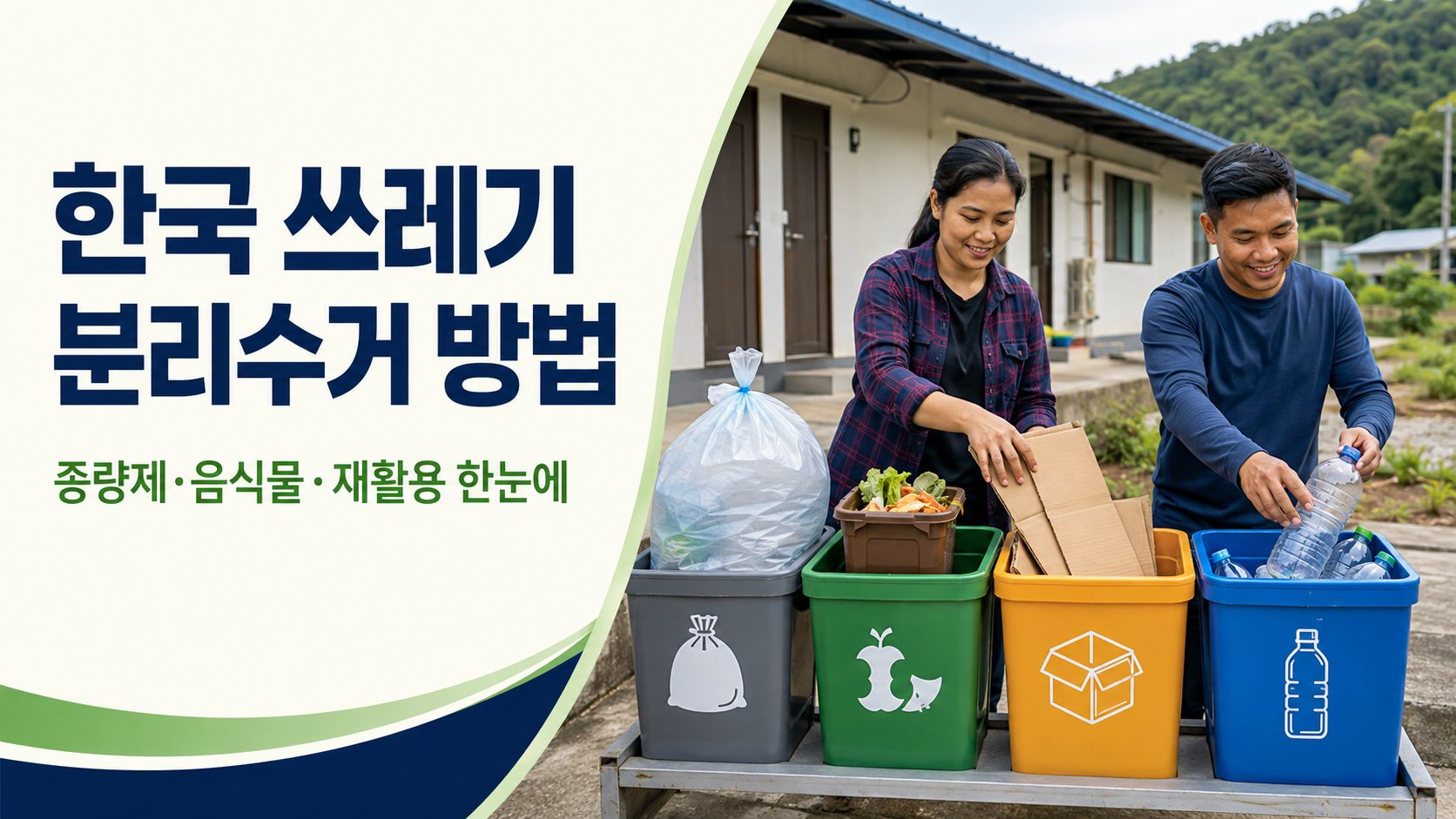
For foreigners who have just started living in Korea, separating waste may seem difficult. This is because there are items that cannot be recycled even if they look like plastic, and there are times when waste from food is not food waste.
The date and time for disposing of trash and the type of volume-rate bag also differ depending on the region. Even for the same item, the disposal method may vary depending on the standards of the city, county, or district where you live and the type of accommodation.
Therefore, it is safest to learn Korea's basic principles of separate disposal and then check the notices posted at your accommodation, your employer or accommodation manager, and the local administrative welfare center.
In this article, we will explain how to dispose of household waste that foreign workers and seasonal workers often encounter in Korea, such as volume-rate bags, food waste, recyclables, bulky waste, and rural agricultural waste.
Table of Contents
- Things to check before throwing away trash
- How to use general waste and volume-rate bags
- Food waste classification and disposal method
- Separate disposal method for each type of recyclable product
- Disposal of waste batteries, waste home appliances, and bulky waste
- Precautions to be taken in rural lodgings and workplaces
- Confusing waste classification examples
- Final garbage disposal checklist
- Frequently Asked Questions
1. Things to check before throwing away trash
Check the discharge days and times in your area
In Korea, you usually have to put out trash on designated days and times. Some areas require collection to occur between dusk and dawn, and there may be days such as Friday or Saturday when collection is not performed.
Apartments often have a separate waste collection site within the complex, but single-family homes and rural lodgings may be required to dispose of their waste at a designated location or village common collection site.
On your first day, we recommend checking the following:
- Days and times to dispose of general waste
- How to dispose of food waste
- Recyclables collection days
- Location of transparent plastic bottle collection box
- Waste battery/fluorescent light collection box location
- How to report bulky waste
- Discharge location closest to accommodation
Discharge methods and volume-rate bag sales locations by region are [Regional information on the household waste separation websiteYou can check it here.
Check the notice posted at the accommodation
Dormitories or shared accommodations provided by employers may operate separate communal living rules in addition to the general local rules.
Please check with the property manager about the location of the waste sorting station, responsible cleaning area, disposal time and how to use the communal waste bin. If you have difficulty understanding Korean signs, it is best to take a photo and translate it or ask an interpreter.
Just because you don't know where to throw your trash, you shouldn't leave it on the side of the road or on an empty lot. If you are not sure of your designated location, you should first check with your employer or local representative.
2. How to use general waste and volume-rate bags
General waste is household waste that cannot be recycled and is not classified as food waste. In most regions, waste is placed in volume-rate bags sold in the region and disposed of at a designated location.
Pay-as-you-go bags can be purchased at convenience stores, supermarkets, and designated sales outlets. In many cases, you cannot use envelopes purchased in other cities, counties, or districts, so please check whether the envelope is the one for your current residence.
Typical items discarded as general waste
- Used tissues and wet tissues
- Diapers and sanitary products
- Disposable mask
- Rubber gloves
- Heavily contaminated vinyl and plastic
- Delivery invoice and thermal receipt
- Coated paper that does not tear easily
- Paper foil and contaminated packaging
- Food packaging materials that cannot be washed cleanly
- Eggshells and animal bones
- Disposable tea bags and herbal medicine residues
Even if it has a recycling symbol, if it is heavily stained with food or oil and is difficult to clean, it may need to be disposed of as general waste.
Wrap sharp objects safely
If sharp objects such as blades, razor blades or broken glass are left in the bag, they may injure the collection worker.
It is safe to wrap it several times in newspaper or thick paper, secure it with tape, and mark the outside with “broken glass” or “danger.” Broken glass and ceramics may require the use of non-combustible gunny bags or special size bags depending on the region, so check the standards in your jurisdiction.
3 . Food waste classification and disposal method
Not everything that comes from food is food waste. After processing, food waste must be able to be used as feed, compost, or biogas raw material.
Depending on the region, dedicated food bags, dedicated collection containers, payment certificates, chips, or RFID devices are used. Food waste should not be mixed with general volume-rate disposal bags.
How to dispose of food waste
- Remove plastic bags, toothpicks and packaging materials.
- Remove as much juice and moisture as possible.
- Reduce the moisture and salt content of foods high in salt, such as kimchi or soy sauce.
- Break large vegetables and fruits into small pieces for easy disposal.
- Dispose of food in accordance with the food disposal method used in the region.
- The dedicated collection container is brought into the accommodation after collection is completed.
Food waste is disposed of by reducing the moisture and removing foreign substances, using a regional volume-based system such as special bags, stickers, chips, or RFID. Detailed basic principles are [Food waste information on the Separate Disposal of Household Waste websiteYou can check it here.
What is not food waste
The following items are representative examples of items that should be disposed of as general waste even if they come from food.
- Bones and hair of animals such as cows, pigs, chickens, etc.
- Fish bones and thick spines
- Hard shells such as clams, conches, abalone, oysters, crabs, etc.
- Egg shells such as eggs and quail eggs
- Hard shells of walnuts, chestnuts, peanuts, coconuts, etc.
- Hard seeds of peaches, persimmons, avocados, etc.
- Dry skins and hard roots of onions, garlic, corn, etc.
- Disposable tea bags and herbal medicine residues
- Toxic by-products such as pufferfish intestines
Government policy guidance also explains that egg shells, animal bones, hard fruit seeds, and dry skins of vegetables should be disposed of in volume-rate bags. For detailed examples [Republic of Korea Policy Briefing Guide to Separate Disposal of Food WasteYou can check it here.
4. How to separate and dispose of recyclables by type
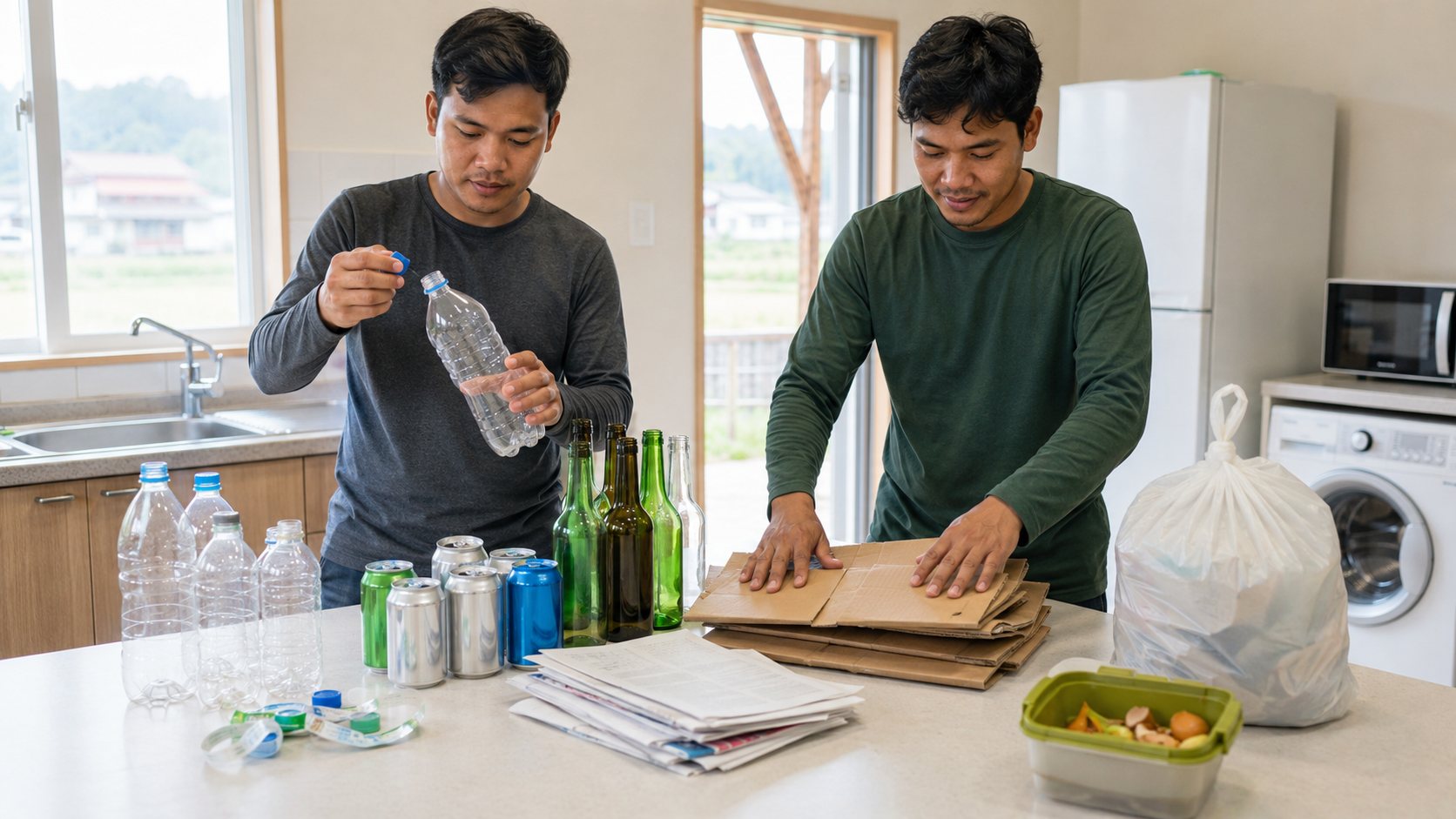
When disposing of recyclables, the basic rule is to empty the contents, rinse them to the extent possible, separate the different materials, and dispose of them without mixing each item.
Food and oil residues can contaminate other recyclables. Rather than using too much water, empty the contents completely and simply rinse and dry.
Paper box and plain paper
The delivery box is disposed of by removing the invoice, tape, iron pins, and plastic, then unfolding or folding it. Store paper so that it does not get wet with water or food.
Newspapers, books, notebooks and leaflets should have plastic covers, springs and other materials removed.
The following items are difficult to recycle with regular paper:
- Thermal receipt
- Courier invoice
- Photo paper
- Paper foil
- Used tissue paper
- Waterproof processed paper
- Cool box with non-separable vinyl or aluminum
Milk cartons and paper cartons
Milk cartons, soymilk cartons and juice cartons are made of different materials from regular paper boxes. The principle is to empty the contents, rinse with water, spread out, dry completely, remove straws and plastic, and dispose of them in a paper pack recycling bin.
If you do not have a dedicated collection box, bundle and dispose of paper separately so that it does not mix with general paper, and check with your local representative for the exact collection location.
Plastic containers and packaging materials
Empty beverage, detergent, shampoo containers and food trays, rinse briefly, and remove labels, pumps, and other materials.
Even if they look like plastic, toothbrushes, hangers, rubber gloves, stationery, and other products that have various materials attached to them and cannot be separated may need to be disposed of as general waste or bulky waste depending on the region.
Colorless and transparent plastic bottle
There are many areas where colorless and transparent PET bottles containing bottled water and beverages are disposed of separately from other plastics.
Prepare in the following order:
- Completely empty the contents.
- Rinse beverage bottles with remaining sugar in water.
- Remove the label completely.
- Compress the plastic bottle to the extent possible.
- Close the lid.
- Place in a transparent PET bottle recycling bin or a transparent/translucent bag. Exhaust.
Colored PET bottles, cooking oil bottles, seasoning bottles and transparent plastic trays are not placed in the colorless and transparent PET bottle collection box.
The Ministry of Environment's separate disposal guidelines instruct people to remove the contents and labels of colorless and transparent bottled water and beverage PET bottles, squeeze them to the extent possible, and then close the lid before discharging. Detailed methods for each item are [Household waste separation websiteYou can search from ].
Vinyls
After emptying the contents of snack bags, ramen bags, and disposable plastic bags, removing foreign substances, collect them in a transparent or translucent bag and dispose of them to prevent them from scattering.
Vinyl that is heavily stained with food and oil, plastic wrap that cannot be washed cleanly, rubber gloves, flooring, and tents are not included in the plastic recycling.
Styrofoam
Clean Styrofoam used as cushioning material for boxes of agricultural and marine products and home appliances is disposed of after removing tape, invoices, and other materials.
Styrofoam that has food on it or is coated or bonded to other materials is difficult to recycle. If contamination cannot be removed, volume-rate bags or special-sized gunny bags must be used according to local standards.
Cans and scrap metal
Empty and rinse beverage and canned food cans and remove plastic caps and other materials.
Butane gas and pesticide containers must be completely removed in a well-ventilated area away from fire or heat sources and then disposed of in accordance with local emission standards. To avoid the risk of fire and explosion, do not mix empty containers with regular recycling.
glass bottle
Empty and rinse beverage and food glass bottles before disposing of them to prevent them from breaking. Bottles subject to an empty container deposit, such as soju bottles and beer bottles, can be returned to the store to receive the deposit.
Broken glass, mirrors, heat-resistant glass, ceramics, chinaware and flower pots should not be placed in the glass bottle collection box. Depending on the region, volume-rate bags, non-combustible gunny bags, or bulky waste reporting are required.
5. Disposal of waste batteries, waste home appliances, and bulky waste
Batteries and auxiliary batteries
Regular batteries, rechargeable batteries and auxiliary batteries should not be placed in general waste or recycling bags. Please use the waste battery collection boxes installed at administrative welfare centers, apartments, supermarkets, and communal collection points.
If the terminals of a lithium battery or auxiliary battery are exposed, the terminals must be wrapped with insulating tape or placed in an individual plastic bag to prevent short circuits and fires.
For toys and small devices with removable batteries, remove the batteries first and place them in the battery collection box. If the battery cannot be removed, dispose of the entire product in a small waste home appliance collection box or a location designated by your local area.
Fluorescent and LED lighting
Dispose of fluorescent lights and LED lights into waste fluorescent light recycling bins to prevent them from breaking. Broken lights must be safely wrapped in newspaper, etc., and then disposed of in a method determined by the region, such as a volume-rate bag or special standard gunny bag.
Furniture and bulky waste
Items that do not fit into volume-rate bags, such as beds, mattresses, desks, chairs, and large suitcases, must be reported as bulky waste.
Usually, items and discharge locations are registered on the city hall, county office, or district office website, a fee is paid, and a report number or sticker is attached. Depending on the region, you can also purchase bulky waste stickers at designated stores.
Leaving undeclared furniture on the street or in front of your accommodation may result in illegal dumping.
Wasted home appliances such as refrigerators and washing machines
You can apply for free in-home collection of waste home appliances such as refrigerators, washing machines, air conditioners, TVs, etc. that meet certain conditions. If you make a reservation online or by phone, a collection agent will visit you.
Free in-home collection of waste home appliances E-circular governance reservation system Or you can call 1599-0903. Collection availability varies depending on region and product type, so please check eligible items before booking.
6. Precautions to be taken in rural lodgings and workplaces
Do not mix household waste and agricultural waste
In rural seasonal worker accommodation, household waste generated at home and agricultural waste generated during work must be separated.
Pesticide containers, waste vinyl from rural areas, and work materials should not be mixed with regular volume-rate bags or household recycling.
Pesticide containers and waste plastic from rural areas
Pesticide containers should be stored at the village common collection site or designated collection site after the contents have been completely used. Do not dispose of remaining pesticides in drains, on the ground or in rivers.
Waste vinyl from rural areas is removed from dirt, gravel and weeds, bundled for easy transport, and disposed of at a village common collection site or designated location.
First check with the farm owner or site manager about how to dispose of waste generated at the workplace. Outdoor burning of agricultural plastic and waste should be avoided as it can cause fire and air pollution.
7. Confusing examples of garbage classification
Cup Ramen Can the container be recycled?
It depends on the material of the container and the state of contamination. If it is a plastic container, empty the contents, wash thoroughly, and check the material label. Paper and Styrofoam containers that are soaked with soup and oil and cannot be cleaned cleanly may need to be disposed of as general waste.
Are pizza boxes made of paper?
Clean parts can be disposed of as paper, but it is better to cut off parts with oil and food and dispose of them as general waste. If you put food on paper, it may contaminate other paper.
Are banana and watermelon peels food waste?
In most regions, soft fruit peels are classified as food waste. However, it is recommended to cut large peels such as watermelons into small pieces to reduce the moisture. Detailed standards may vary by region, so please check the instructions together.
Do I put broken dishes in the glass bottle collection box?
No. Stoneware, ceramics and heat-resistant glass are different from glass bottles and should not be placed in the glass bottle collection box. Wrap it safely in paper or a box and dispose of it in a volume-rate bag, non-combustible gunny bag, or in a method prescribed by the region.
Can I put old clothes in the clothing recycling bin?
Clean, dry clothes that can be reused by others can be placed in the clothing collection bin. Do not place wet or heavily soiled clothes, blankets, pillows, cushions and dolls in clothing collection bins, but dispose of them in volume-rate bags or bulky waste according to local standards.
8. Final garbage disposal checklist
- [ ] I confirmed the waste disposal location of the accommodation.
- [ ] Confirmed the day and time of general waste discharge.
- [ ] We have prepared volume-rate bags for the current region.
- [ ] Water and foreign substances from food waste were removed.
- [ ] The contents of the recycling were emptied and briefly rinsed.
- [ ] The invoice and tape were removed from the paper box.
- [ ] The label on the transparent plastic bottle has been removed.
- [ ] Used batteries and auxiliary batteries were stored separately.
- [ ] Bulky waste was reported before discharge.
- [ ] Rural waste plastic and pesticide containers were separated from household waste.
9. Frequently Asked Questions
Where can I buy pay-as-you-go bags?
You can purchase it at local convenience stores, supermarkets, and designated sales outlets. Each store may handle different sizes, so please tell us how much capacity you need and check if the bag is designed specifically for your area.
Can I throw away general waste in a black bag?
In most areas, general waste must be placed in designated volume-rate bags. If you use black bags or regular plastic bags, they may not be collected, so please use volume-rate bags exclusively for your local area.
Do recyclables need to be washed thoroughly with soap?
You don't always need to use soap. Simply empty the contents completely and simply rinse to remove any food or foreign substances that would interfere with recycling. Packaging materials that are difficult to clean and are heavily contaminated may need to be disposed of as general waste.
If I don’t know the discharge day, where can I ask?
Please contact the accommodation manager, farm owner, administrative welfare center, or the cleaning department at the city hall, county office, or district office. You can also check the discharge days and locations by region and volume-rate bag sales offices on the household waste separation website.
Will I be fined for incorrectly disposing of trash?
Failure to use volume-rate bags, disposing of waste in undesignated areas, or improperly mixing recyclables and food waste may be subject to crackdowns or fines according to local ordinances. You must check the guidance of your area of residence for the exact standards and amounts.
Finish
To properly dispose of trash in Korea, you must first distinguish between general trash, food waste, and recyclables.
For general waste, use local volume-rate bags, and for food waste, remove moisture and foreign substances and dispose of them according to the dedicated method. It is important to empty recyclables, rinse them and remove any other materials.
In particular, egg shells, animal bones, shells and hard fruit seeds are not food waste, and used batteries and auxiliary batteries are a fire hazard and should be disposed of in a dedicated collection bin.
Lastly, discharge days and locations vary by region, so be sure to check accommodation instructions and the latest standards of your local government.
※ This article is general information based on official data as of August 2026. Collection items, discharge days, bag types and bulky waste disposal methods may vary by region, so please first check the guidance of the city/county/district where you live.
Related articles
- Rules for living in shared accommodation for seasonal workers in Korea | Electricity, heating, cooling, cleaning, fire prevention
- 10 things to check on the first day of entry for seasonal workers in Korea | Documents, accommodation, bankbook, insurance, emergency contact information
- How to use buses and taxis in rural areas in Korea|Information on transportation cards, trains, and apps for seasonal workers