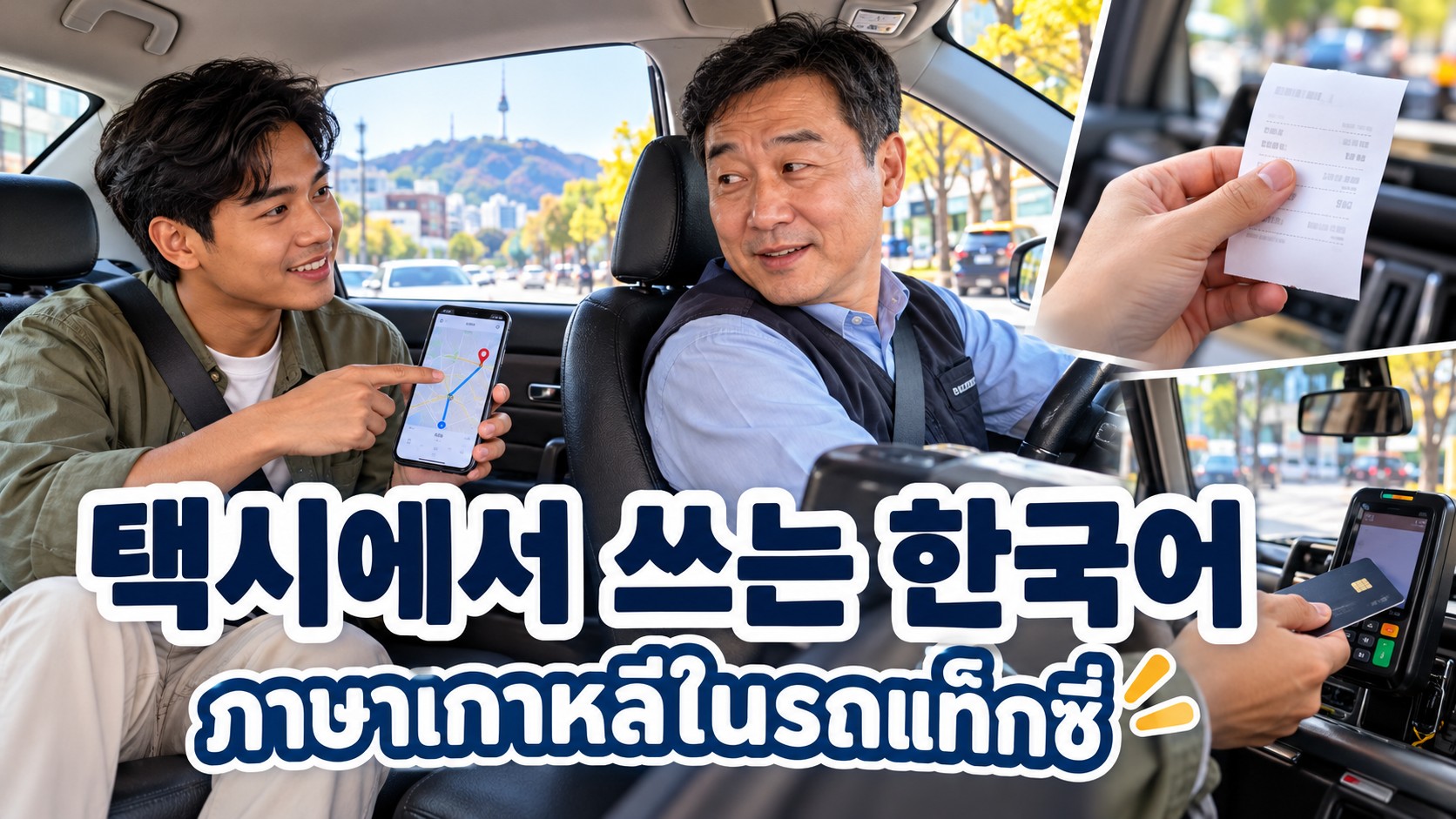
In a taxi, a short explanation is more helpful than a long explanation, showing the exact destination and confirming what you need before paying and getting off. In this episode, we practice Korean expressions from the moment you deliver your address to the moment you collect your receipt and luggage. This is not a guide that guarantees the actual fare or card acceptance, but rather a language learning text in which the passenger asks the taxi driver for the necessary confirmation.
The Korean sentences in bold and their Thai meanings below are designed to remain the same even if you change the site language. It is up to the speaker to choose the polite ending in Thai that suits him or her. The pronunciation help written in Thai letters is a reference for reading closer to Korean sounds and does not represent all accurate pronunciations. After practicing by dividing sentences into short sentences, check the other person's answers in an actual conversation.
Prepare your destination before departure
Prepare your Korean address and map location in advance, and make sure it is where you want to go. If you use an app to call a taxi, check to make sure the pick-up location and arrival location are not reversed. Show your destination when the vehicle is safely stopped, and speak without interfering with the taxi driver's driving while moving. The following conversation is a hypothetical situation for practice purposes and is not a transcript of what an actual taxi driver or business operator would say.
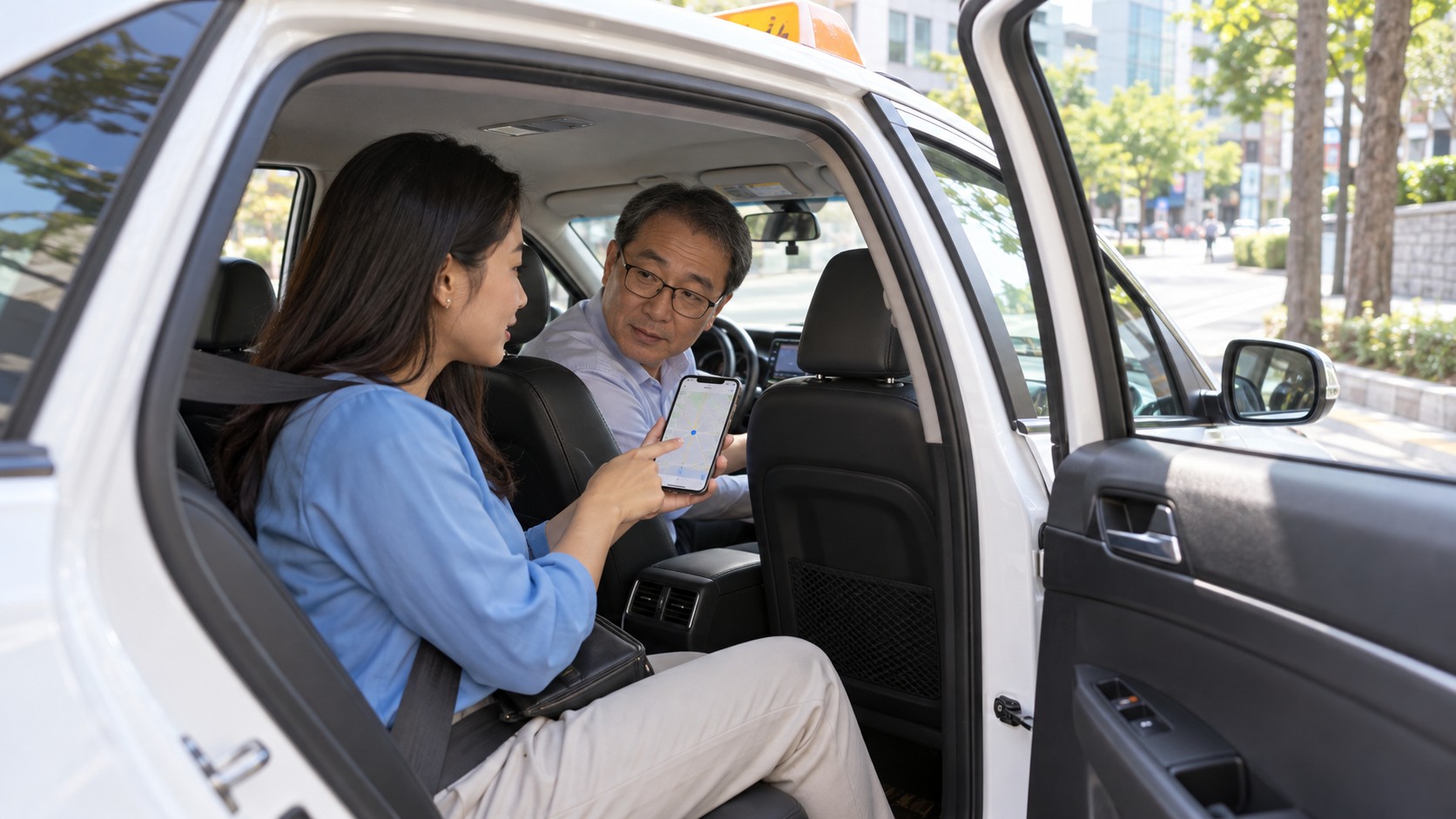
1. When informing the destination by address
이 주소로 가 주세요.
Thai meaning: ช่วยไปส่งตามที่อยู่นี้หน่อยค่ะ/ครับ
Pronunciation help: อี จู-โซ-โร คา จู-เซ-โย
Thai usage context: ใช้เมื่อขึ้นแท็กซี่และต้องการแสดงที่อยู่ปลายทางให้คนขับดู
There may be buildings or stores with similar names, so please show the Korean address and map location of your destination. When returning to your accommodation, it may be helpful to have the exact address provided by the accommodation ready rather than just showing the accommodation name on the reservation screen. This is an expression used to check whether the passenger and the taxi driver are looking at the same place before departure.
short conversation
Passenger: 이 주소로 가 주세요.
ช่วยไปส่งตามที่อยู่นี้หน่อยค่ะ/ครับ
Taxi driver: 네, 이 주소로 가겠습니다.
ได้ค่ะ/ครับ จะไปตามที่อยู่นี้
Precautions when using: On your mobile phone, only open the screen with the destination information. There is no need to show the screen showing your passport number or password. If you find it difficult to hand your phone to a taxi driver, make the text appear larger, but don't ask the taxi driver to keep looking at the screen while he or she is driving.
To repeat: 이 주소로 가 주세요. Read the sentences slowly and think about what situation you would say to the taxi driver.
2. When checking whether the location marked on the map is correct
이곳이 맞아요?
Thai meaning: ใช่ที่นี่ไหมคะ/ครับ
Pronunciation help: อี-โก-ชี มา-จา-โย
Thai usage context: ใช้ถามยืนยันว่าจุดที่แสดงบนแผนที่คือสถานที่ที่ต้องการไปหรือไม่
What you want to check here is the destination shown on the map. After showing the address, compare the location the taxi driver found on the map with the location you prepared. If you just talk and don't look at the screen, you may have different understandings of where you are pointing.
short conversation
Passenger: 이곳이 맞아요?
ใช่ที่นี่ไหมคะ/ครับ
Taxi driver: 네, 지도에 표시된 곳이 맞습니다.
ใช่ค่ะ/ครับ เป็นจุดที่แสดงบนแผนที่
Precautions when using: This sentence alone does not provide a new description of the destination. If the viewing positions are different, please show the address and building name again. Don't ask long questions while the taxi driver is driving. After the car has come to a complete stop, the passenger can ask the taxi driver to repeat the destination shown on the map.
To repeat: 이곳이 맞아요? Read the sentences slowly and think about what situation you would say to the taxi driver.
3. When asking for a safe place to stop when getting off
안전한 곳에 세워 주세요.
Thai meaning: ช่วยจอดในที่ปลอดภัยให้หน่อยค่ะ/ครับ
Pronunciation help: อัน-จอน-ฮัน โก-เซ เซ-วอ จู-เซ-โย
Thai usage context: ใช้เมื่อต้องการลงจากรถและขอให้คนขับจอดในจุดที่ปลอดภัย
Even if you can see your destination building, you may not be able to stop right in front of it. This expression is when a passenger asks the driver to find a safe location and stop the car. Passengers must not open the doors of a moving taxi. Do not urge the taxi driver to stop the car suddenly.
short conversation
Passenger: 안전한 곳에 세워 주세요.
ช่วยจอดในที่ปลอดภัยให้หน่อยค่ะ/ครับ
Taxi driver: 앞쪽의 안전한 곳에 세우겠습니다.
จะจอดในจุดที่ปลอดภัยข้างหน้าค่ะ/ครับ
Precautions when using: Get out after the car has come to a complete stop. Before opening the door, look for pedestrians and bicycles outside, and check the directions to see which side is safe to get off. Prioritize a safe location to stop, even if it means moving a little further than you want.
To repeat: 안전한 곳에 세워 주세요. Read the sentences slowly and think about what situation you would say to the taxi driver.
4. When a passenger asks a taxi driver whether card payment is possible
카드로 결제할 수 있어요?
Thai meaning: ชำระด้วยบัตรได้ไหมคะ/ครับ
Pronunciation help: คา-ดือ-โร คยอล-เจ-ฮัล ซู อี-ซอ-โย
Thai usage context: ใช้ถามก่อนชำระเงินว่าบัตรที่ตนมีสามารถใช้จ่ายค่าแท็กซี่ได้หรือไม่
This sentence asks you to confirm your payment method. You can verify this by showing the card you will use, but you do not need to send a photo of your entire card number or tell them your password. It is a good idea to check your payment method before departure, and then check the amount and processing result again when making the actual payment upon arrival.
short conversation
Passenger: 카드로 결제할 수 있어요?
ชำระด้วยบัตรได้ไหมคะ/ครับ
Taxi driver: 네, 카드로 결제하실 수 있습니다.
ได้ค่ะ/ครับ ชำระด้วยบัตรได้
Precautions when using: The answer in the example conversation does not mean that all cards will be accepted in all taxis. Check whether the card payment device is working properly and that cards issued overseas can be used. Also check the payment settings of your taxi-hailing app. If you have set up automatic payment in the app, first check to see if the payment has already been processed and avoid paying the same fee repeatedly.
To repeat: 카드로 결제할 수 있어요? Read the sentences slowly and think about what situation you would say to the taxi driver.
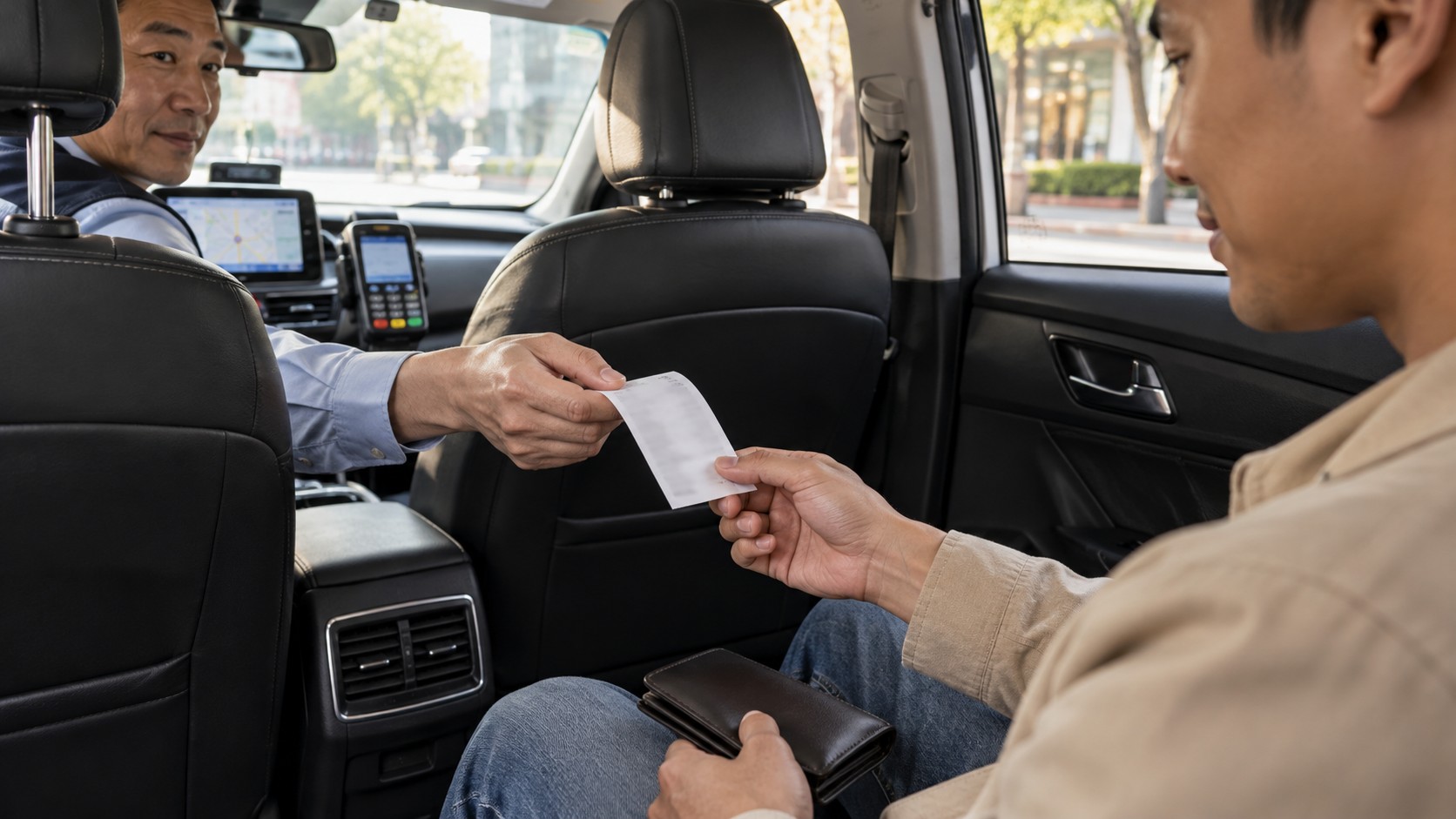
5. When requesting a receipt after payment
영수증 주세요.
Thai meaning: ขอใบเสร็จด้วยค่ะ/ครับ
Pronunciation help: ยอง-ซู-จึง จู-เซ-โย
Thai usage context: ใช้หลังชำระค่าแท็กซี่เมื่อต้องการขอใบเสร็จเพื่อเก็บข้อมูลการเดินทาง
A receipt is a document that confirms the details of a transaction in which money was exchanged. After paying the taxi fare, passengers must receive a receipt from the taxi driver and keep it. The receipt will be helpful later when you find out that you left something in the taxi or when you want to check the details of your taxi use. Check the date and amount on the receipt, and if the writing is hard to see, ask the taxi driver to check it while the vehicle is stopped.
short conversation
Passenger: 영수증 주세요.
ขอใบเสร็จด้วยค่ะ/ครับ
Taxi driver: 여기 영수증 있습니다.
นี่ใบเสร็จค่ะ/ครับ
Precautions when using: Seoul City's taxi inconvenience information also provides information such as date of use, license plate number, destination, fare, and receipt. Application routes for other regions must be confirmed with the relevant local government. Simply receiving a receipt does not guarantee that lost items will be returned or fees will be refunded.
To repeat: 영수증 주세요. Read the sentences slowly and think about what situation you would say to the taxi driver.
6. When a passenger asks a taxi driver to open the trunk
트렁크를 열어 주세요.
Thai meaning: ช่วยเปิดท้ายรถให้หน่อยค่ะ/ครับ
Pronunciation help: ทือ-รอง-คือ-รึล ยอ-รอ จู-เซ-โย
Thai usage context: ใช้เมื่อรถจอดสนิทแล้วและต้องการนำสัมภาระออกจากท้ายรถ
If you put a large bag in the trunk, once you arrive at your destination, please tell the taxi driver that your luggage is in the trunk. It's easy to forget your luggage when you're focused on paying and checking your phone. After the car has completely stopped in a safe place, passengers must remove all small items from the back seat and large bags from the trunk.
short conversation
Passenger: 트렁크를 열어 주세요.
ช่วยเปิดท้ายรถให้หน่อยค่ะ/ครับ
Taxi driver: 네, 차가 완전히 멈추면 열어 드리겠습니다.
ได้ค่ะ/ครับ จะเปิดให้เมื่อรถจอดสนิทแล้ว
Precautions when using: Do not ask to open the trunk or move behind the vehicle while the car is moving. After the taxi driver stops the car in a safe place, the passenger takes out the luggage from the trunk. Do not rush out into the direction of other vehicles, but make sure you have all your belongings before moving on.
To repeat: 트렁크를 열어 주세요. Read the sentences slowly and think about what situation you would say to the taxi driver.
Switch roles and practice one more time
One person takes on the role of a passenger and the other takes on the role of a taxi driver. The passenger shows the prepared map screen and says the destination, and the taxi driver answers the confirmed location. Practice the order in which passengers listen to the taxi driver's answer, check again to see if it is the same place, and then depart. Change to the situation where the car has stopped safely at the destination, then check the payment method, receipt, and luggage in the trunk.
Even if you have memorized the sentence, communication may be misaligned if it points to a different destination than the actual intended destination. Practice preparing your address accurately and asking short Korean questions together. If passengers do not understand the answer, they can ask the taxi driver to explain it again. With the taxi safely stopped, check your destination and payment method on the screen or with a translation tool, then pay the fare according to what you confirmed and get off.
Articles to read along with official resources referenced
Data confirmation date: 2026-10-30. Expressions and conversations have been reorganized to suit learning purposes. For actual taxi use, fares, and reporting procedures, please check the latest information for your area and service.