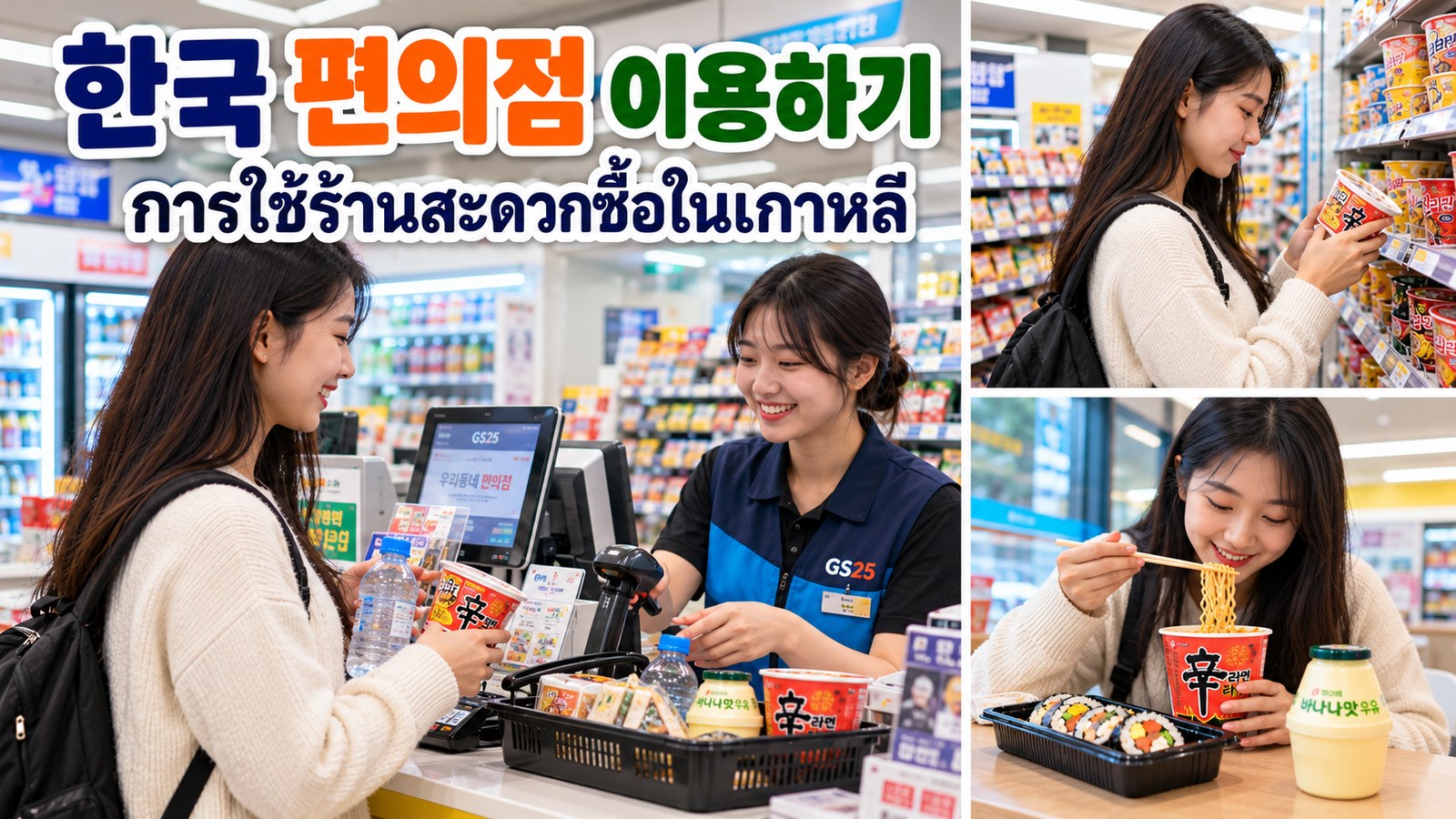
When you first enter a convenience store in Korea, everything from finding items to paying can be unfamiliar. In this article, we will practice a situation where a customer looking for cup ramen and a drink asks an employee for the location of the items, pays the bill, and then checks to see if the food can be eaten inside the store.
Even if you are not yet familiar with Korean, there is no need to memorize long sentences. Just ask questions one at a time and listen to the employee's answers until the end. The dialogue below was created for learning purposes. hypothetical situationThis does not include actual confirmation of product location, price, bag provision, or in-store dining availability for each store.
1. Ask for the location of an object
If you can't find the product you want, ask a staff member first. Distinguish between sentences spoken by customers to employees and sentences answered by employees to customers, as their roles are different.
expression 1
Korean 컵라면은 어디에 있어요?
Thai meaning บะหมี่ถ้วยอยู่ตรงไหนคะ/ครับ
Pronunciation help (roughly written in Thai characters) ค็อบ-รา-มยอน-ึน ออ-ดี-เอ อิซ-ซอ-โย
This is a situation where a customer asks where the cup ramen is placed. You can rephrase it by putting another product name in front of it.
expression 2
Korean 저쪽 진열대에 있어요.
Thai meaning อยู่ที่ชั้นวางสินค้าทางโน้นค่ะ/ครับ
Pronunciation help (roughly written in Thai characters) ชอ-จ๊ก จิน-ยอล-แด-เอ อิซ-ซอ-โย
This is an answer from the employee telling you where the item is located. Customers check not only what they say, but also the direction the staff member is pointing.

2. Ask for a shopping bag and receipt at the checkout counter.
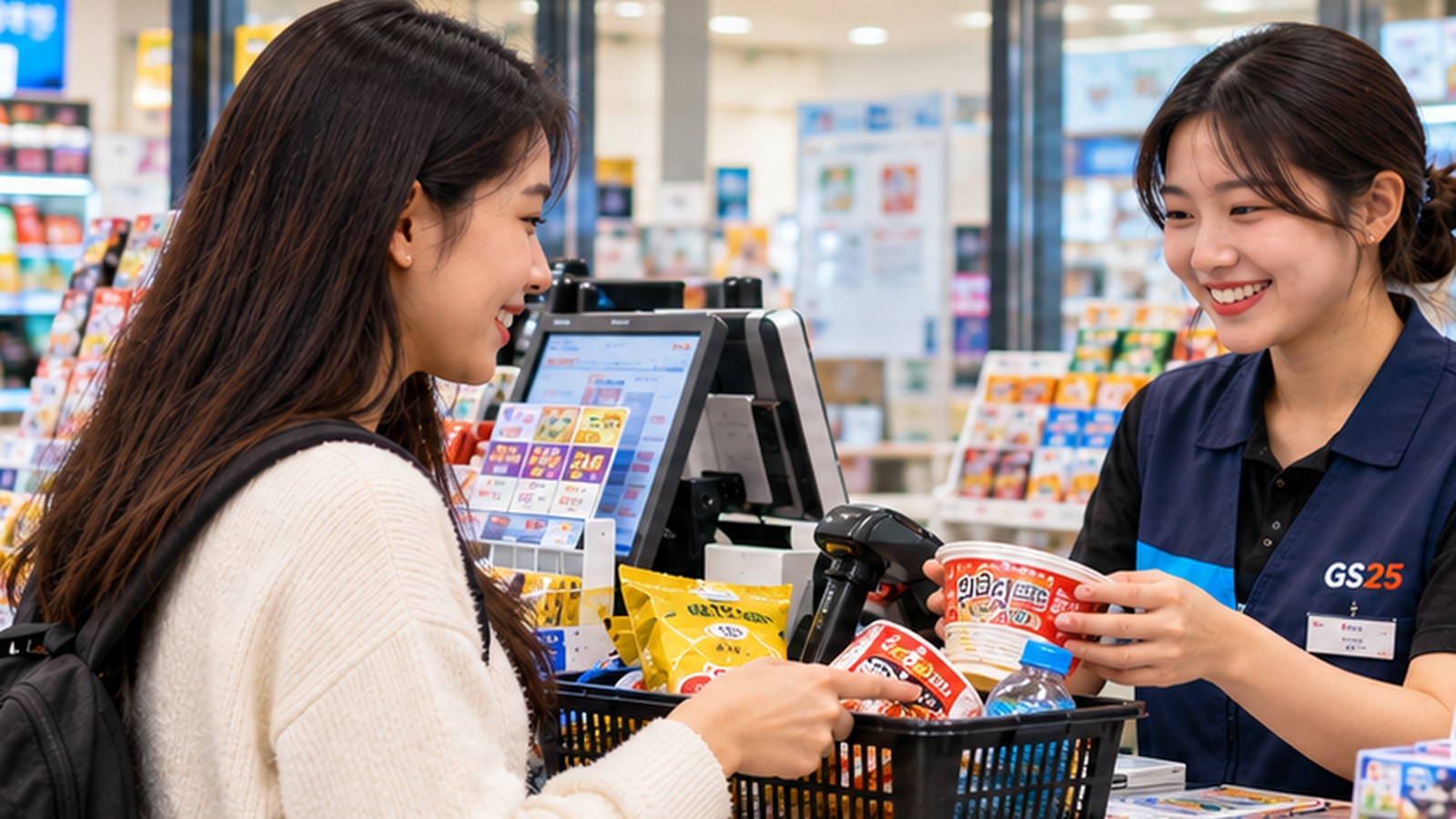
After choosing the items, make the necessary requests one by one at the checkout counter. If you are unclear about the price tag or packaging, it is best to check with a staff member before paying.
expression 3
Korean 이거 계산해 주세요.
Thai meaning ช่วยคิดเงินอันนี้ให้หน่อยค่ะ/ครับ
Pronunciation help (roughly written in Thai characters) อี-กอ คเย-ซัน-แฮ จู-เซ-โย
The customer uses this expression to ask the employee to ring up the selected items. Placing the items on the checkout counter makes the request clear.
expression 4
Korean 봉투 하나 주세요.
Thai meaning ขอถุงหนึ่งใบค่ะ/ครับ
Pronunciation help (roughly written in Thai characters) พง-ทู ฮา-นา จู-เซ-โย
This is an expression in which a customer requests a bag to put an item in. You'll need to check with the store to see if bags are provided and for additional costs.
expression 5
Korean 영수증도 주세요.
Thai meaning ขอใบเสร็จด้วยค่ะ/ครับ
Pronunciation help (roughly written in Thai characters) ยอง-ซู-จึง-โด จู-เซ-โย
The customer uses this expression to ask for a receipt when paying. The word 도 adds this request to something else already requested.
3. Check if you can eat food in the store
Just because you buy something doesn't mean you can sit down and eat it at any convenience store. Even if there appears to be a seat available, ask if it is available and follow the staff's instructions.
expression 6
Korean 여기에서 먹어도 돼요?
Thai meaning ทานอาหารตรงนี้ได้ไหมคะ/ครับ
Pronunciation help (roughly written in Thai characters) ยอ-กี-เอ-ซอ มอ-กอ-โด ดแว-โย
The customer asks permission to eat food using the seat inside the store. The answer may vary from store to store.
expression 7
Korean 여기에서는 드시면 안 돼요.
Thai meaning ห้ามรับประทานอาหารบริเวณนี้ค่ะ/ครับ
Pronunciation help (roughly written in Thai characters) ยอ-กี-เอ-ซอ-นึน ทือ-ชี-มยอน อัน ดแว-โย
This is an expression used by employees to inform people that eating in this place is not allowed. This does not mean permission, and you must separately ask if another seat is available.
The pronunciation guide writes Korean sounds approximately in Thai characters. It does not exactly reproduce Korean pronunciation, so also practise listening and repeating.
4. Short Situational Dialogue: Asking an Employee Where an Item Is
Below is a hypothetical conversation where a customer is looking for cup ramen. Read each line one by one and learn the other person's answers as well.
- 손님: 안녕하세요. 컵라면은 어디에 있어요? — ลูกค้า: สวัสดีค่ะ/ครับ บะหมี่ถ้วยอยู่ตรงไหนคะ/ครับ
- 직원: 저쪽 진열대에 있어요. — พนักงาน: อยู่ที่ชั้นวางสินค้าทางโน้นค่ะ/ครับ
- 손님: 감사합니다. — ลูกค้า: ขอบคุณค่ะ/ครับ
- 직원: 네, 천천히 보세요. — พนักงาน: ได้เลยค่ะ/ครับ เชิญเลือกดูตามสบาย
5. Short Situational Dialogue: Calculation and Seat Checking
Below is also a practice conversation. The answers given by the staff are only examples and you should check with the on-site staff for actual store availability.
- 손님: 이거 계산해 주세요. — ลูกค้า: ช่วยคิดเงินอันนี้ให้หน่อยค่ะ/ครับ
- 직원: 봉투 필요하세요? — พนักงาน: ต้องการถุงไหมคะ/ครับ
- 손님: 네, 봉투 하나 주세요. 영수증도 주세요. — ลูกค้า: ค่ะ/ครับ ขอถุงหนึ่งใบและขอใบเสร็จด้วยค่ะ/ครับ
- 직원: 네, 알겠습니다. — พนักงาน: ได้เลยค่ะ/ครับ
- 손님: 여기에서 먹어도 돼요? — ลูกค้า: ทานอาหารตรงนี้ได้ไหมคะ/ครับ
- 직원: 네, 저쪽 자리에서 드세요. — พนักงาน: ได้ค่ะ/ครับ เชิญรับประทานที่นั่งทางโน้น
6. Differences that are easily misunderstood and staff's guidance on prohibitions
- Guest request and staff response: 봉투 하나 주세요.This is a request from a customer. 봉투 필요하세요?is a question the staff asks the guests.
- Receipt and shopping bag: A receipt is a paper or electronic record confirming payment. A shopping bag holds the items you bought. They are different things.
- Permissions and Prohibitions: 여기에서 먹어도 돼요?is a question asking for permission. 여기에서는 드시면 안 돼요.is a prohibited expression that means you must not eat it. The meaning of the two sentences should not be interchanged.
- Cost and availability criteria: Do not assume shopping bags are free. Check product and bag prices, and whether eating in the store is allowed, with that particular store.
If you have been told by a staff member that you are prohibited from eating, do not continue eating in the same place, but ask again if there are other seats available or take out and go.
7. Practice speaking directly
Read the situation below, speak it to yourself in Korean first, and then check the sample answer. This is a virtual practice situation and is not a substitute for actual store guidance.
Situation A: You cannot find the cup ramen. Ask an employee where it is.
Speaking Answer: 컵라면은 어디에 있어요? / บะหมี่ถ้วยอยู่ตรงไหนคะ/ครับ
Situation B: When paying, ask for one shopping bag and a receipt.
Speaking Answer: 봉투 하나 주세요. 영수증도 주세요. / ขอถุงหนึ่งใบและขอใบเสร็จด้วยค่ะ/ครับ
Situation C: Not sure if you can eat inside the store. I ask permission first.
Speaking Answer: 여기에서 먹어도 돼요? / ทานอาหารตรงนี้ได้ไหมคะ/ครับ
8. Text and language materials that are good to read next time
If you want to check the price or quantity of the product again, Language for Living in Korea Part 3: Korean for checking prices, quantities, and unitsRead together. This is a previous learning article that was actually published.
If you want to find more everyday Korean words and meanings, visit the National Institute of the Korean Language. Basic Korean Dictionary and Korean-Thai Learning DictionaryYou can use . Official site access confirmation date: 2026-11-02. The conversation and pronunciation help in this article are self-examples for learning purposes and are not a direct reproduction of official example sentences from the dictionary.
Both the representative image and the main text image are explanatory images created using artificial intelligence. This photo does not confirm or recommend the actual store, staff, prices, or usage policies.