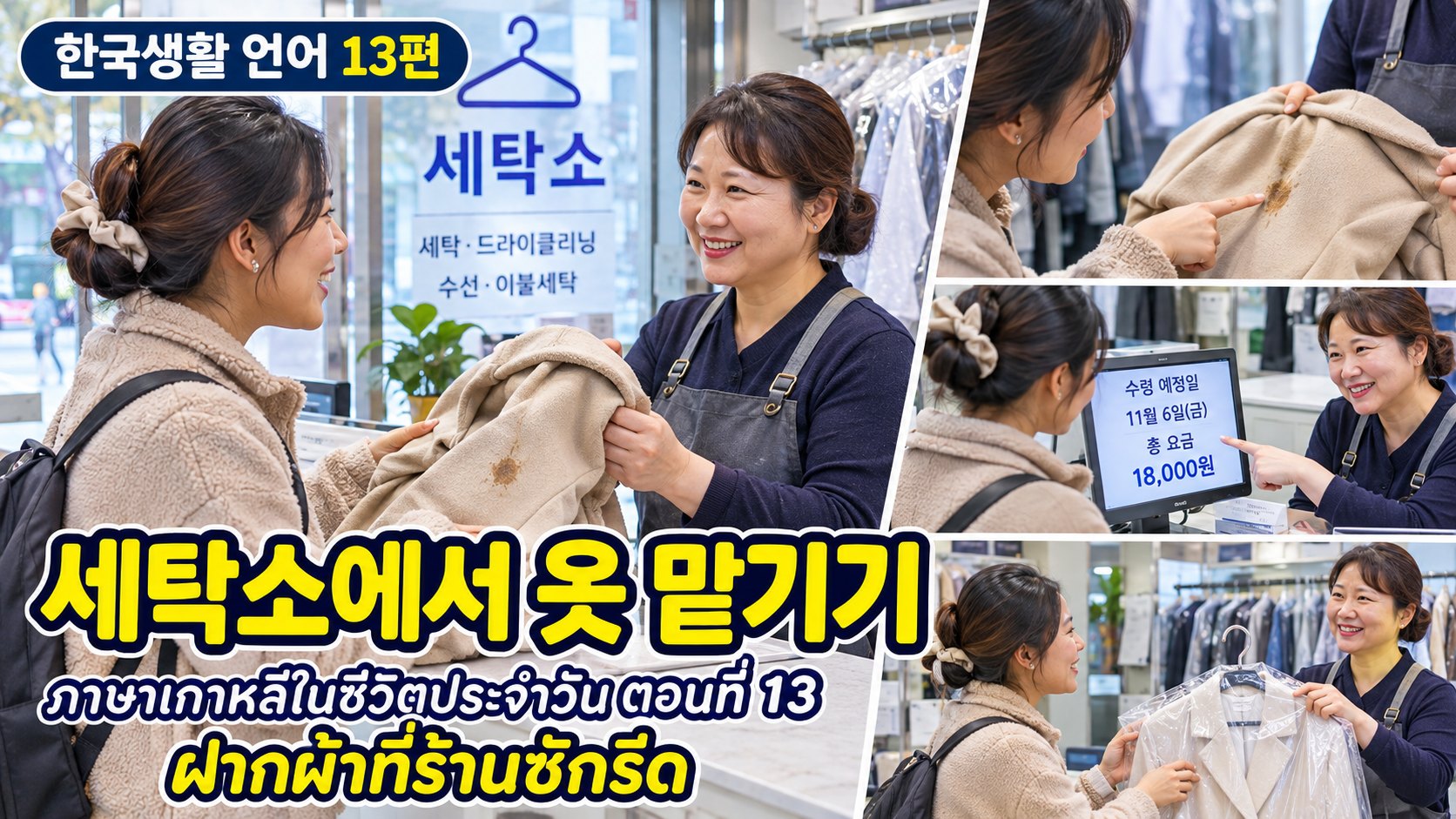
On your first visit to a dry-cleaning shop, you may feel unsure where to put your clothes, how to explain a stain, or when to return for collection. Today, we follow one situation in which a customer talks to a shop employee about leaving a stained coat for cleaning. Learn the expressions while clearly distinguishing the customer's requests from the employee's replies.
The pickup date and price shown on the screen in the cover image are fictional examples for illustration, not actual store information. They do not mean that any particular shop guarantees that price or date.
All dialogues, dates, and amounts in this article are fictional examples for learning. The actual cleaning method, whether a stain can be removed, the collection date, and the price depend on the shop and the condition of the clothing. Do not agree to leave the clothing or assume the cost is final before checking the conditions explained by the employee.
1. Entering the shop, leaving clothes, and explaining a stain
A Korean dry-cleaning shop where an employee takes your clothes and arranges the cleaning works differently from a self-service laundromat where you operate the washer and dryer yourself. The expressions below are for a dry-cleaning shop where you leave clothes with an employee in the situation described here.
Expression 1: 이 옷을 세탁하려고 왔어요.
Korean phrase: 이 옷을 세탁하려고 왔어요.
Natural Thai meaning: ฉันนำเสื้อผ้าชิ้นนี้มาซักค่ะ/ครับ
Pronunciation help (approximation in Thai script): อี โอซึล เซทักฮารยอโก วัซซอโย
When do you use it? The customer shows the employee the clothing and explains that they have come to have it cleaned.
Avoid this misunderstanding: you are asking to leave clothes for cleaning, not saying that you want to buy clothes.
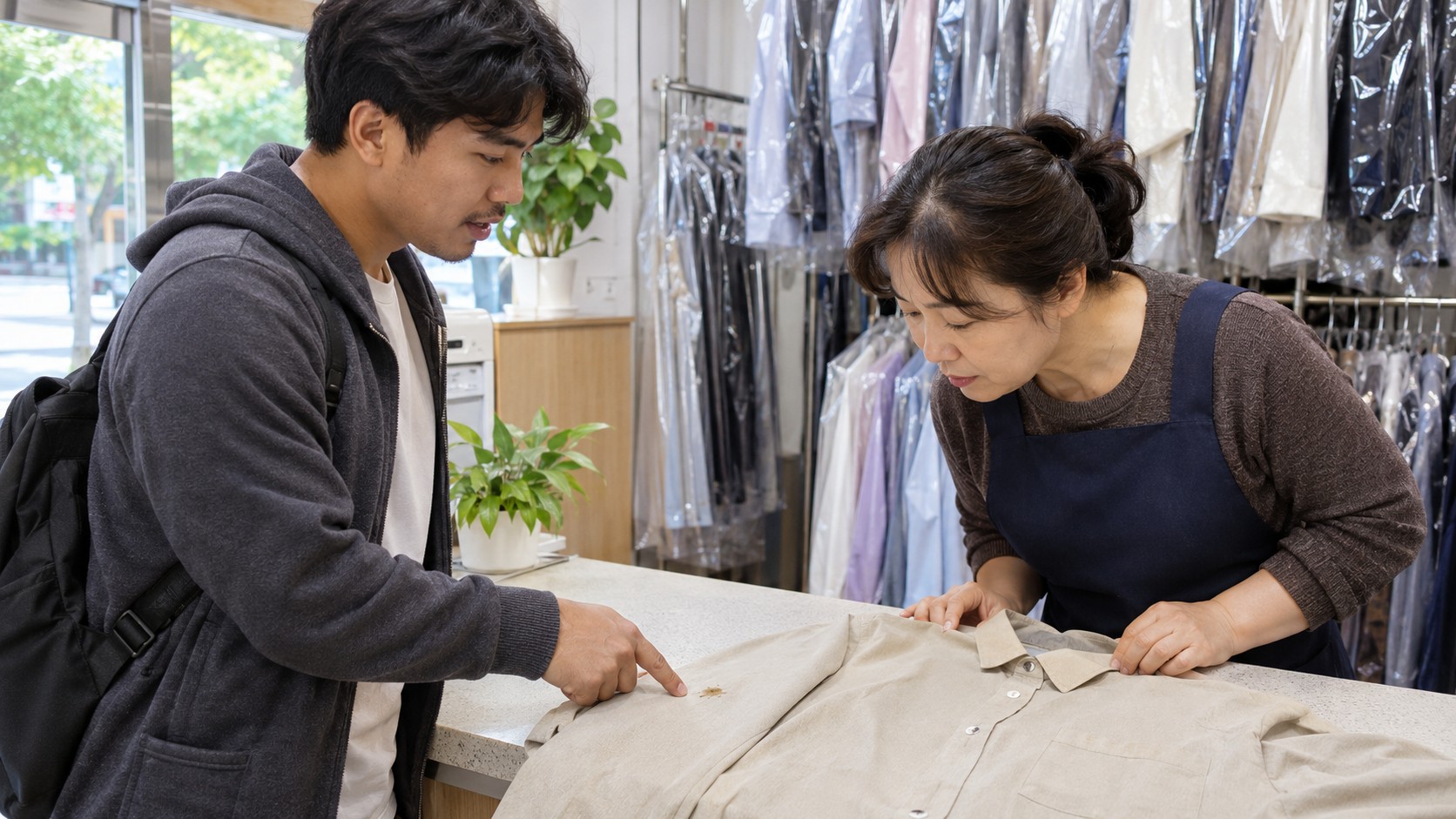
Expression 2: 여기 얼룩이 있어요.
Korean phrase: 여기 얼룩이 있어요.
Natural Thai meaning: ตรงนี้มีคราบเปื้อนค่ะ/ครับ
Pronunciation help (approximation in Thai script): ยอกี ออลลุกี อิซซอโย
When do you use it? The customer points to the stained area of the garment.
Avoid this misunderstanding: this identifies the visible stain; it does not mean the stain can definitely be removed.
Expression 3: 이 얼룩을 지울 수 있을까요?
Korean phrase: 이 얼룩을 지울 수 있을까요?
Natural Thai meaning: คราบนี้สามารถขจัดออกได้ไหมคะ/ครับ
Pronunciation help (approximation in Thai script): อี ออลลุกึล จีอุล ซู อิซซึลกกาโย
When do you use it? Before leaving the clothing, the customer asks whether the stain can be removed.
Avoid this misunderstanding: this is a question, not confirmation that stain removal has been guaranteed.
Expression 4: 이 옷은 어떻게 세탁하나요?
Korean phrase: 이 옷은 어떻게 세탁하나요?
Natural Thai meaning: เสื้อผ้าชิ้นนี้ซักด้วยวิธีไหนคะ/ครับ
Pronunciation help (approximation in Thai script): อี โอซึน ออตตอเค เซทาคานาโย
When do you use it? The customer asks the employee how the garment will be cleaned.
Avoid this misunderstanding: in this example, you are asking which method the shop will use, rather than asking for instructions on washing the garment yourself at home.
2. Checking the collection date and price
Before deciding to leave your clothes, check which day you can collect them, and what is included in the quoted amount together. It is important to distinguish an agreed time from the time when collection is actually available.
Expression 5: 언제 찾으러 오면 될까요?
Korean phrase: 언제 찾으러 오면 될까요?
Natural Thai meaning: ควรมารับเสื้อผ้าคืนเมื่อไหร่คะ/ครับ
Pronunciation help (approximation in Thai script): ออนเจ ชาจือรอ โอมยอน ดเวลกกาโย
When do you use it? The customer asks on which date they can return to collect the clothes they left with the shop.
Avoid this misunderstanding: here, the verb means returning to collect the clothing you left, not searching for lost property.
Expression 6: 총 얼마예요?
Korean phrase: 총 얼마예요?
Natural Thai meaning: รวมทั้งหมดเป็นเงินเท่าไหร่คะ/ครับ
Pronunciation help (approximation in Thai script): ชง ออลมาเยโย
When do you use it? The customer asks for the full amount, including all relevant items.
Avoid this misunderstanding: ask what the amount includes so that you do not confuse the price of one item with the total.
Expression 7: 추가 비용이 있나요?
Korean phrase: 추가 비용이 있나요?
Natural Thai meaning: มีค่าใช้จ่ายเพิ่มเติมไหมคะ/ครับ
Pronunciation help (approximation in Thai script): ชูกา พียงี อิซนาโย
When do you use it? The customer asks whether stain treatment or other separate work will increase the cost.
Avoid this misunderstanding: this asks whether there are extra charges; it does not state that there are none.
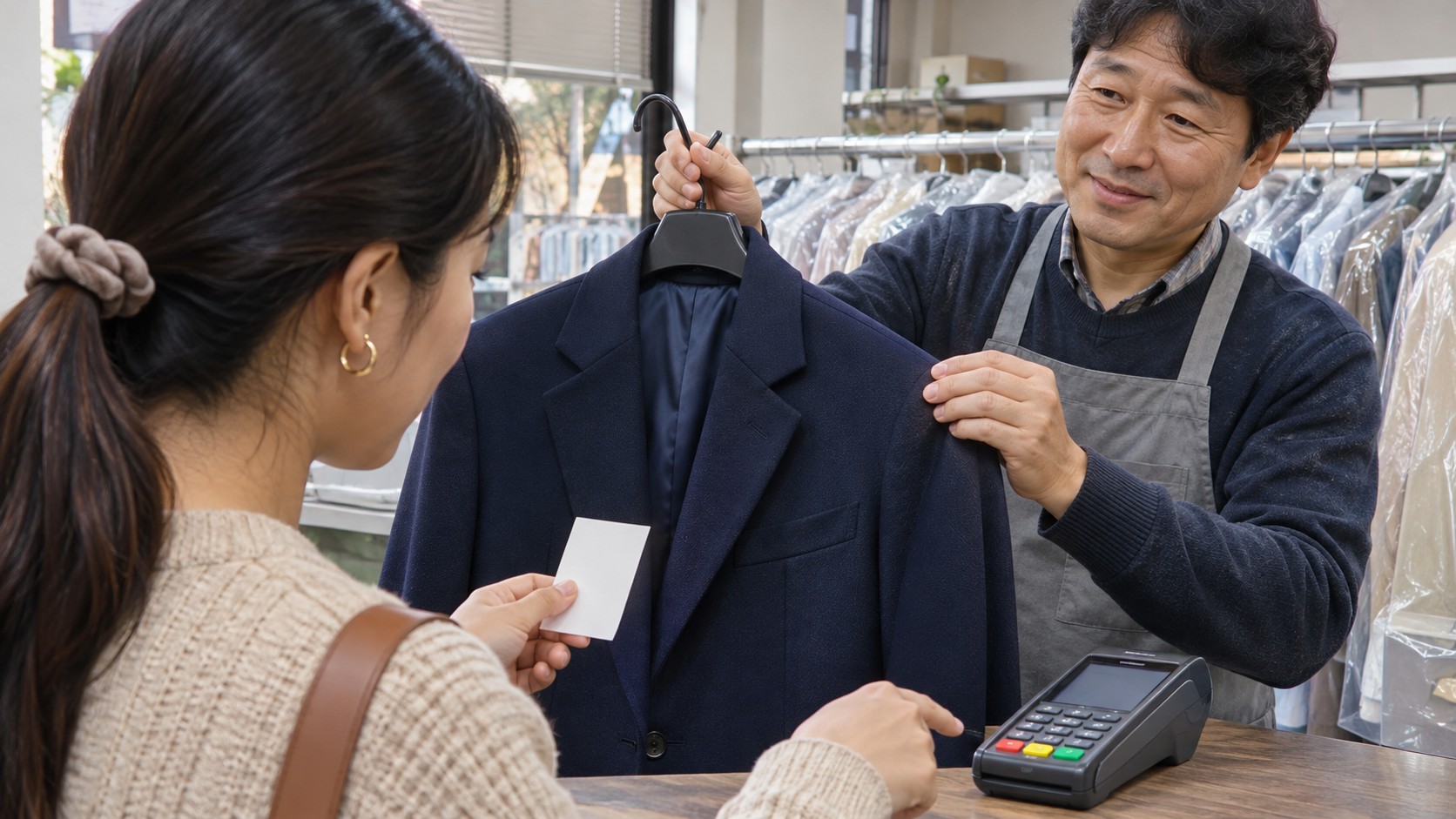
Expression 8: 접수증을 받을 수 있을까요?
Korean phrase: 접수증을 받을 수 있을까요?
Natural Thai meaning: ขอใบรับฝากผ้าได้ไหมคะ/ครับ
Pronunciation help (approximation in Thai script): จ็อบซูจึงึล พาดึล ซู อิซซึลกกาโย
When do you use it? The customer asks for a record that can be used to check the clothing left with the shop and the collection conditions.
Avoid this misunderstanding: the type of confirmation provided varies by shop; it may be on paper or sent by text message.
3. Practise a realistic dialogue: the customer asks and the employee replies
The following fictional dialogue practises asking short questions in sequence instead of saying everything at once. The employee's replies do not represent any particular shop's actual services or prices.
- 손님: 안녕하세요. 이 옷을 세탁하려고 왔어요. — ลูกค้า: สวัสดีค่ะ/ครับ ฉันนำเสื้อผ้าชิ้นนี้มาซักค่ะ/ครับ
- 직원: 네, 옷을 보여 주세요. — พนักงาน: ได้ค่ะ/ครับ ขอชมเสื้อผ้าหน่อยค่ะ/ครับ
- 손님: 여기 얼룩이 있어요. 이 얼룩을 지울 수 있을까요? — ลูกค้า: ตรงนี้มีคราบเปื้อนค่ะ/ครับ คราบนี้สามารถขจัดออกได้ไหมคะ/ครับ
- 직원: 상태를 보고 가능 여부를 안내해 드릴게요. — พนักงาน: ขอพิจารณาสภาพผ้าก่อน แล้วจะแจ้งว่าสามารถขจัดคราบได้หรือไม่ค่ะ/ครับ
- 손님: 언제 찾으러 오면 될까요? — ลูกค้า: ควรมารับเสื้อผ้าคืนเมื่อไหร่คะ/ครับ
- 직원: 가능한 날짜를 확인해서 알려 드릴게요. — พนักงาน: จะตรวจสอบวันที่สามารถมารับได้แล้วแจ้งให้ทราบค่ะ/ครับ
- 손님: 총 얼마예요? 추가 비용이 있나요? — ลูกค้า: รวมทั้งหมดเป็นเงินเท่าไหร่คะ/ครับ มีค่าใช้จ่ายเพิ่มเติมไหมคะ/ครับ
- 직원: 작업 내용을 확인한 뒤 금액을 말씀드릴게요. — พนักงาน: จะตรวจสอบรายละเอียดการซักก่อน แล้วแจ้งราคาให้ทราบค่ะ/ครับ
- 손님: 접수증을 받을 수 있을까요? — ลูกค้า: ขอใบรับฝากผ้าได้ไหมคะ/ครับ
- 직원: 네, 접수 내용을 확인해 드릴게요. — พนักงาน: ได้ค่ะ/ครับ จะตรวจสอบรายละเอียดการรับฝากให้ค่ะ/ครับ
The employee has only said that they will check the possible date and the price. In this dialogue, neither the cleaning completion date nor the total price has been confirmed. Wait for that check and then listen again to the conditions actually offered.
4. Similar expressions that can be confusing
- 세탁하다 and 맡기다: 세탁하다 (ซักหรือทำความสะอาดผ้า) / 맡기다 (ฝากไว้ให้ร้านดูแล). Cleaning means making clothes clean; leaving them with the shop means handing them over and asking the shop to keep and handle them.
- Collecting clothes and losing clothes: 옷을 찾으러 오다 (มารับเสื้อผ้าคืน) / 옷을 잃어버리다 (ทำเสื้อผ้าหาย). In this context, coming to collect clothes means picking up clothes that you previously left with the shop. Do not understand it as saying that you have lost your clothes.
- 가능합니다 and saying that you will check: 가능합니다 (ทำได้) / 확인해 보겠습니다 (จะตรวจสอบดูก่อน). Saying that they will check means that the employee has not yet determined whether it is possible. Do not interpret it as a firm promise.
- The total price and extra charges: 총 얼마예요? (รวมทั้งหมดเท่าไหร่) / 추가 비용이 있나요? (มีค่าใช้จ่ายเพิ่มเติมไหม). The first question asks for the full amount; the second checks whether there are charges added separately.
5. Speaking practice: ask one question at a time at the dry-cleaning shop
For the first exercise, imagine the clothing in front of you and speak slowly. For the second, imagine listening to the employee's reply and distinguish between agreement and a response that is still awaiting confirmation. The sentences below are examples created for learning.
- Point to a stain on a sleeve and say: 여기 얼룩이 있어요. — ตรงนี้มีคราบเปื้อนค่ะ/ครับ
- Ask whether the stain can be removed: 이 얼룩을 지울 수 있을까요? — คราบนี้สามารถขจัดออกได้ไหมคะ/ครับ
- Ask when you can collect the clothing from the shop: 언제 찾으러 오면 될까요? — ควรมารับเสื้อผ้าคืนเมื่อไหร่คะ/ครับ
- Ask separately about the total and any additional charges: 총 얼마예요? 추가 비용이 있나요? — รวมทั้งหมดเท่าไหร่ มีค่าใช้จ่ายเพิ่มเติมไหมคะ/ครับ
- Ask for a record confirming that you left the clothes: 접수증을 받을 수 있을까요? — ขอใบรับฝากผ้าได้ไหมคะ/ครับ
The pronunciation guide uses Thai script as a learning aid and cannot fully reproduce accurate Korean sounds. When reading aloud, practise one sentence at a time with pauses instead of trying to say the whole passage in one go.
6. Five things to check at the shop
- Check that the employee correctly understands the number and condition of the garments you are leaving.
- Distinguish between the shop still checking whether the stain can be removed and the shop telling you that removal is possible.
- Check what the employee has explained about the cleaning method and any risk of damage to the garment.
- Confirm the actual collection date and how to check the record of your order.
- Agree only after checking which work is included in the total price and whether there are separate additional charges.
If you did not catch the service details or price, politely ask the employee to repeat them. If they have only said that they will check the date and amount, the conditions are not yet confirmed. Each shop may use different records and payment methods, so do not treat the expressions in this lesson as rules that apply to every shop.
Related reading: Practical Life in Korea, Part 8 — Washing, drying, and paying at a self-service laundromat. Unlike the dry-cleaning shop dialogue in this lesson, that article explains how customers operate the machines themselves at a self-service laundromat.
Public learning resource for checking more Korean vocabulary: Korean Basic Dictionary, National Institute of Korean Language. This official website provides a dictionary for Korean learners and a Korean–Thai learner's dictionary. Checked on: 2026-11-03. This is a language-learning reference resource, not an authority that certifies the services, prices, or working hours of individual dry-cleaning shops.