Practice example Adapt the sample message to your situation. It is an illustrative example.
Show your map to check which bus to take
여기에서 [목적지] 쪽으로 가는 [버스 번호]번 버스를 타면 될까요? 제가 내려야 할 정류장을 지도에서 짚어 주실 수 있어요?
Can I take bus [number] from here toward [destination]? Could you point out the stop where I should get off on the map?
Save the Korean name of your destination, the stop where you need to get off, and the bus number together. If someone says 건너편, check the stop on the opposite side and confirm the direction before boarding.
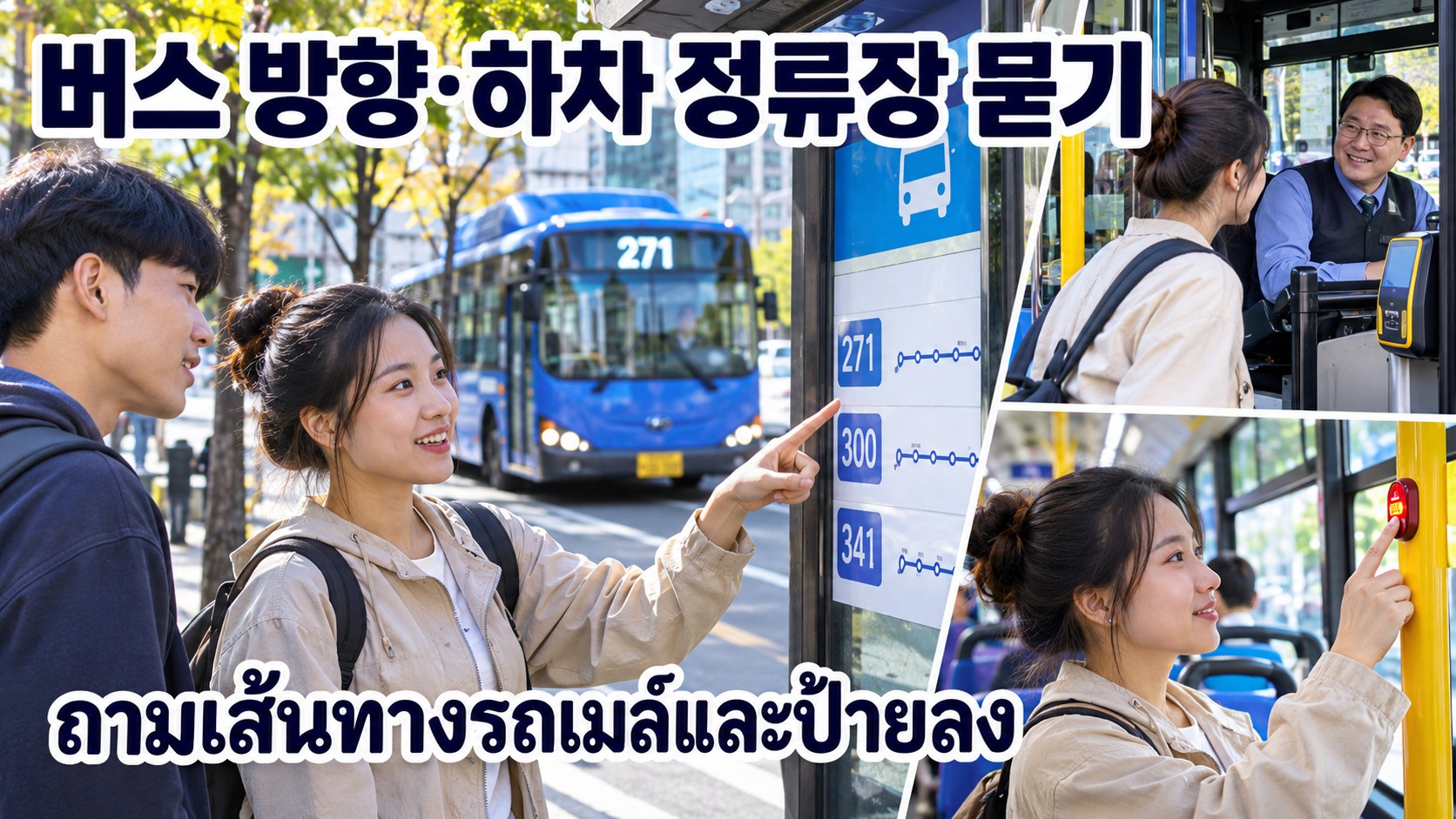
When you first use a bus in Korea, you may need to check the direction of the stop and where to board even if the bus number looks right. In this lesson, follow one connected situation: show your destination and ask a question, confirm the directions you receive, and learn what to say when getting off.
All people and dialogues are fictional examples created for learning. Route numbers and stop signs in the images do not confirm any real service route or arrival time. Check current service information before boarding. If you are unsure, ask again from a safe place.
Situation 1. Ask whether you can take the bus from this stop
When there are bus stops on both sides of a major road, buses may travel in opposite directions even if the stops share a place name. Show the other person the written name of your destination and clearly ask whether you can board on this side.
Korean expression: 이 버스가 그쪽으로 가나요?
Thai meaning: รถเมล์คันนี้ไปทางนั้นไหม
Pronunciation guide: i beo-seu-ga geu-jjok-eu-ro ga-na-yo
Use this while pointing to your destination or showing it on a map. It is different from simply asking whether the bus has arrived.
Korean expression: 여기에서 타면 되나요?
Thai meaning: ขึ้นรถที่ตรงนี้ได้ใช่ไหม
Pronunciation guide: yeo-gi-e-seo ta-myeon doe-na-yo
This question checks whether the stop where you are standing is the correct boarding point. It does not guarantee permission to board or ask the bus to stop.

Situation 2. Check your stop before you need to get off
After boarding, you can check the current and next stops through announcements or the display. If the destination name is difficult, show a note or map and ask which stop you should get off at. Ask while the bus is stopped or when it is otherwise safe, instead of keeping the driver in a long conversation while driving.
Korean expression: 어느 정류장에서 내려야 하나요?
Thai meaning: ต้องลงที่ป้ายไหน
Pronunciation guide: eo-neu jeong-ryu-jang-e-seo nae-ryeo-ya ha-na-yo
Use this when you do not know where to get off. It is not a request to stop the bus immediately.
Korean expression: 다음 정류장이 맞나요?
Thai meaning: ป้ายถัดไปใช่ไหม
Pronunciation guide: da-eum jeong-ryu-jang-i mat-na-yo
This question confirms whether the place you were told about is the very next stop. Check calmly instead of getting off while you are still unsure.
Korean expression: 아직 안 내렸어요.
Thai meaning: ยังไม่ได้ลงรถ
Pronunciation guide: a-jik an nae-ryeot-seo-yo
Use this to distinguish having already got off from still being on the bus. It is different from saying that you have not arrived yet.
Situation 3. Check the stop bell and transport card reader
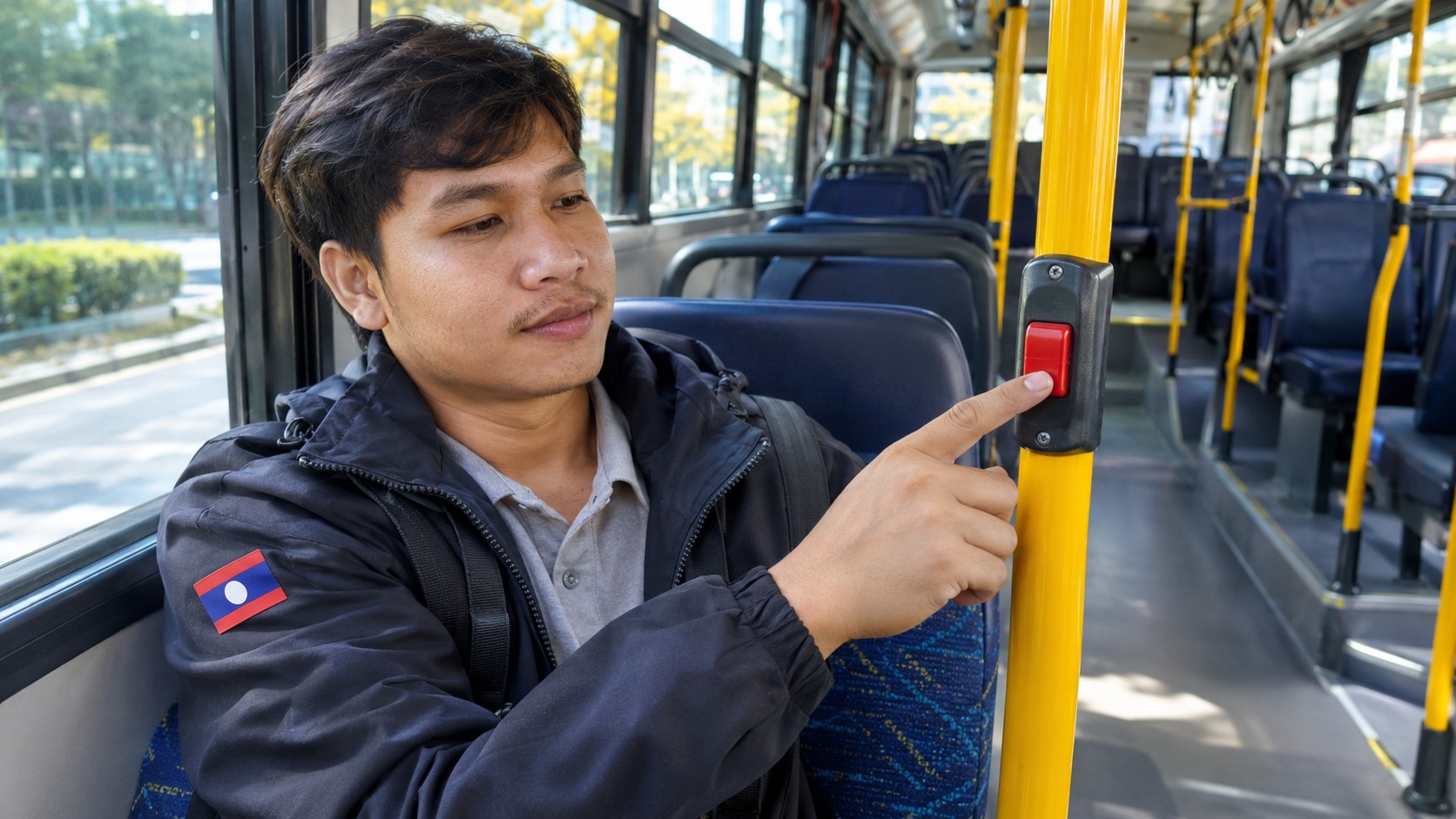
Seoul's official bus guide explains that you press the stop bell as you approach your destination stop and tap your transport card on the reader when getting off. This example is based on Seoul's guidance. Boarding and exit arrangements can differ by region and vehicle type, so check the instructions displayed on the vehicle first.
Korean expression: 여기에서 내려도 되나요?
Thai meaning: ลงที่นี่ได้ไหม
Pronunciation guide: yeo-gi-e-seo nae-ryeo-do doe-na-yo
This question checks where to get off when the vehicle has stopped in a safe place. Do not use it to ask for the door to be opened while the vehicle is moving.
Korean expression: 카드를 여기 대면 되나요?
Thai meaning: แตะบัตรตรงนี้ใช่ไหม
Pronunciation guide: ka-deu-reul yeo-gi dae-myeon doe-na-yo
Point to the reader and use this expression if you are unsure where to tap your transport card. The sentence does not guarantee a fare or eligibility for a transfer discount.
Short dialogue 1. At the bus stop
The following dialogue is a fictional exercise in checking the direction of your destination. It does not provide an actual bus number or stop location.
Passenger: 실례합니다. 여기에서 타면 되나요?
Thai meaning: ขอโทษนะคะ/ครับ ขึ้นรถที่ตรงนี้ได้ใช่ไหม
Person giving directions: 어디로 가세요?
Thai meaning: จะไปที่ไหนครับ/คะ
Passenger: 이 버스가 그쪽으로 가나요?
Thai meaning: รถเมล์คันนี้ไปทางนั้นไหม
Person giving directions: 이쪽 방향이 아니에요. 반대편 정류장을 확인해 보세요.
Thai meaning: ไม่ใช่ทิศทางนี้ ลองตรวจสอบป้ายฝั่งตรงข้ามนะครับ/คะ
Short dialogue 2. On the bus
This is a fictional exercise in which a passenger who is not yet familiar with stop names asks the person beside them. Other passengers may not be responsible for the route, so also check the display, announcements and current route information.
Passenger: 어느 정류장에서 내려야 하나요?
Thai meaning: ต้องลงที่ป้ายไหน
Person giving directions: 다음 정류장인지 안내 화면을 같이 볼까요?
Thai meaning: มาดูหน้าจอประกาศด้วยกันไหมว่าป้ายถัดไปใช่หรือไม่
Passenger: 다음 정류장이 맞나요?
Thai meaning: ป้ายถัดไปใช่ไหม
Person giving directions: 네, 안내 화면에서 이름을 다시 확인해 보세요.
Thai meaning: ใช่ครับ/ค่ะ ลองตรวจสอบชื่อบนหน้าจออีกครั้ง
Expressions that are easy to confuse and safe actions
Getting on a bus means entering the vehicle, while getting off a bus means leaving it. The verbs describe opposite directions, so take care not to swap them when asking about your destination.
The next stop is the stop you will reach ahead, not the place where you are now. The opposite stop may mean a stop across the road. Do not cross without checking; look for a pedestrian crossing and check the traffic signals.
Do not move around or ask the driver for a lengthy explanation while the bus is moving. The stop bell signals that you want to get off; it does not guarantee an immediate stop at any location you choose.
Practice speaking on your own and check before a real trip
First, imagine standing at a bus stop, marking your destination on your phone map and asking which direction to take. Then practice asking where to get off while on the bus, followed by checking the card reader once the vehicle has stopped safely.
Practice saying: 여기에서 타면 되나요? ขึ้นรถที่ตรงนี้ได้ใช่ไหม yeo-gi-e-seo ta-myeon doe-na-yo
Practice saying: 어느 정류장에서 내려야 하나요? ต้องลงที่ป้ายไหน eo-neu jeong-ryu-jang-e-seo nae-ryeo-ya ha-na-yo
Practice saying: 카드를 여기 대면 되나요? แตะบัตรตรงนี้ใช่ไหม ka-deu-reul yeo-gi dae-myeon doe-na-yo
Before setting out, check the actual route, the direction you need to board in and your destination stop. Once on the bus, look at the stop information and locate the stop bell. If you do not know how to use your transport card, read the instructions on the vehicle and ask again when it is safe.
Official information and further reading
Sources checked: 2026-11-06. Boarding and exit procedures were checked against the Seoul Metropolitan Government's public transport guide. The expressions and dialogues in this article were composed for learning; they do not confirm routes, fares or bus timetables.
Official source: Seoul Metropolitan Government public transport guide
Earlier related article: Korean for Life in Korea, Part 9|Confirming your destination in a taxi
What to say when the same bus number stops on both sides
The same bus number stops on both sides. Which side should I board on to get to [name of the stop]?