
Practice example Adapt the sample message to your situation. It is an illustrative example.
Copy a message when you are running late after work
죄송해요. 오늘 퇴근이 늦어져서 [원래 시간]에는 도착하기 어려워요. [새 시간]에 [장소와 출구 번호]에서 만나도 괜찮을까요?
Sorry, I’m finishing work late and probably can’t arrive by [original time]. Could we meet at [new time] at [place and exit number]?
Send the new time you can actually make. Wait for a reply, then confirm the date, time, place and exit number. If the reply says “See you there,” check whether you both mean the same exit and whether you should wait inside or outside.
You may need to change plans with a friend or coworker because something else comes up or your journey is delayed. Sending only a new time can leave the other person unsure whether the original meeting is cancelled or simply rescheduled. Ask whether a change is possible, wait for their reply, and then confirm the date, time, and place together.
This lesson uses polite expressions for everyday meetings. The times and places below are practice examples; replace them with your own details. You can use the expressions to ask about changing an appointment with a shop or an organisation, but the booking desk must confirm whether the change is possible.
Prepare three details before you make contact
Check the original arrangement, a new time when you are available, and whether the meeting place will stay the same. If you expect to be late, contact the other person when you realise it rather than after the agreed time has passed. A brief apology and a specific suggestion are easier to understand than a long explanation. Do not assume the change is confirmed until the other person accepts the new time.
The reading guide is an approximate romanisation to help you say the words aloud. It does not replace the original pronunciation, so practise slowly in short groups of words. The Thai meanings include polite endings for male and female speakers. Choose the ending that suits you.
1. Ask whether you can change the arrangement
Korean: 죄송하지만, 약속 시간을 바꿀 수 있을까요?
Thai meaning: ขอโทษนะครับ/คะ ขอเปลี่ยนเวลานัดได้ไหมครับ/คะ
Reading guide: Joe-song-ha-ji-man, yak-ssok si-ga-neul ba-kkul su i-sseul-kka-yo?
Use this first when you want to change a time you have already agreed on. If needed, briefly explain why and then suggest a time when you are available. You are asking whether a change is possible, not deciding the other person's schedule for them.
Short dialogue
You: 죄송하지만, 약속 시간을 바꿀 수 있을까요?
Your line in Thai: ขอโทษนะครับ/คะ ขอเปลี่ยนเวลานัดได้ไหมครับ/คะ
Other person: 언제가 괜찮으세요?
Their line in Thai: สะดวกเมื่อไรครับ/คะ
Sending the request does not confirm the new time if you receive no reply. If the original meeting time is approaching and you still have no answer, try another way to contact the person.
2. Suggest a specific new time
Korean: 오늘 오후 네 시는 괜찮으세요?
Thai meaning: วันนี้ตอนสี่โมงเย็นสะดวกไหมครับ/คะ
Reading guide: O-neul o-hu ne si-neun gwaen-cha-neu-se-yo?
When the other person asks when you are available, include the day and whether you mean morning or afternoon. A vague suggestion to meet later can lead to repeated questions. Suggest one time first; if it does not work, agree on another.
Short dialogue
You: 오늘 오후 네 시는 괜찮으세요?
Your line in Thai: วันนี้ตอนสี่โมงเย็นสะดวกไหมครับ/คะ
Other person: 네, 그 시간은 괜찮아요.
Their line in Thai: ได้ครับ/ค่ะ เวลานั้นสะดวก
Without morning or afternoon, the same number may mean a different time to each person. If you contact someone late at night around midnight, or read a message much later, confirm the month and day as well.
3. Decline an unsuitable time and offer an alternative
Korean: 그 시간은 어려워요. 오후 다섯 시는 어떠세요?
Thai meaning: เวลานั้นไม่สะดวกครับ/ค่ะ ถ้าเป็นห้าโมงเย็นได้ไหมครับ/คะ
Reading guide: Geu si-ga-neun eo-ryeo-wo-yo. O-hu da-seot si-neun eo-tteo-se-yo?
Use this when you cannot make the suggested time. Here, saying that the time is difficult means it is hard to attend then. It does not necessarily mean you do not want to meet. Adding a time when you are available gives the other person a clear alternative.
Short dialogue
You: 그 시간은 어려워요. 오후 다섯 시는 어떠세요?
Your line in Thai: เวลานั้นไม่สะดวกครับ/ค่ะ ถ้าเป็นห้าโมงเย็นได้ไหมครับ/คะ
Other person: 좋아요. 다섯 시에 만나요.
Their line in Thai: ตกลงครับ/ค่ะ เจอกันตอนห้าโมง
Give a time you can actually manage instead of agreeing to an impossible time and changing it again later. If you do not yet know which day you are available, explain that you will get back in touch once you know.

4. Confirm the building and exact meeting point
Korean: 어디에서 만나면 될까요?
Thai meaning: เราควรเจอกันที่ไหนครับ/คะ
Reading guide: Eo-di-e-seo man-na-myeon doel-kka-yo?
Use this to ask for the meeting point after agreeing on a time. A building can have several entrances even when you both know its name. Confirm which entrance and whether you will meet indoors or outside. If you have never been there, ask for the map location too.
Short dialogue
You: 어디에서 만나면 될까요?
Your line in Thai: เราควรเจอกันที่ไหนครับ/คะ
Other person: 도서관 정문 앞에서 만나요.
Their line in Thai: เจอกันหน้าประตูหลักของห้องสมุดครับ/ค่ะ
Even a photograph may show a similar building at a different location. Compare the building name with the map location. If you do not know the exact meeting point, ask again instead of pretending to understand and setting off.
5. Repeat the agreed details in one sentence
Korean: 그러면 오늘 오후 다섯 시에 도서관 정문 앞에서 만나요.
Thai meaning: ถ้าอย่างนั้น เจอกันวันนี้ตอนห้าโมงเย็น หน้าประตูหลักของห้องสมุดนะครับ/คะ
Reading guide: Geu-reo-myeon o-neul o-hu da-seot si-e do-seo-gwan jeong-mun a-pe-seo man-na-yo.
Before ending the conversation, repeat the day, time, and place together. This gives the other person a chance to correct any difference in understanding. If you arranged it by phone, a short message with the same details is useful to check before leaving.
Short dialogue
You: 그러면 오늘 오후 다섯 시에 도서관 정문 앞에서 만나요.
Your line in Thai: ถ้าอย่างนั้น เจอกันวันนี้ตอนห้าโมงเย็น หน้าประตูหลักของห้องสมุดนะครับ/คะ
Other person: 네, 알겠어요. 그때 만나요.
Their line in Thai: ครับ/ค่ะ เข้าใจแล้ว แล้วเจอกันตามเวลานั้นนะครับ/คะ
Even if only the time changed, confirm that the place is still the same. If what the other person said differs from your message, agree on the final details together instead of deciding by yourself.
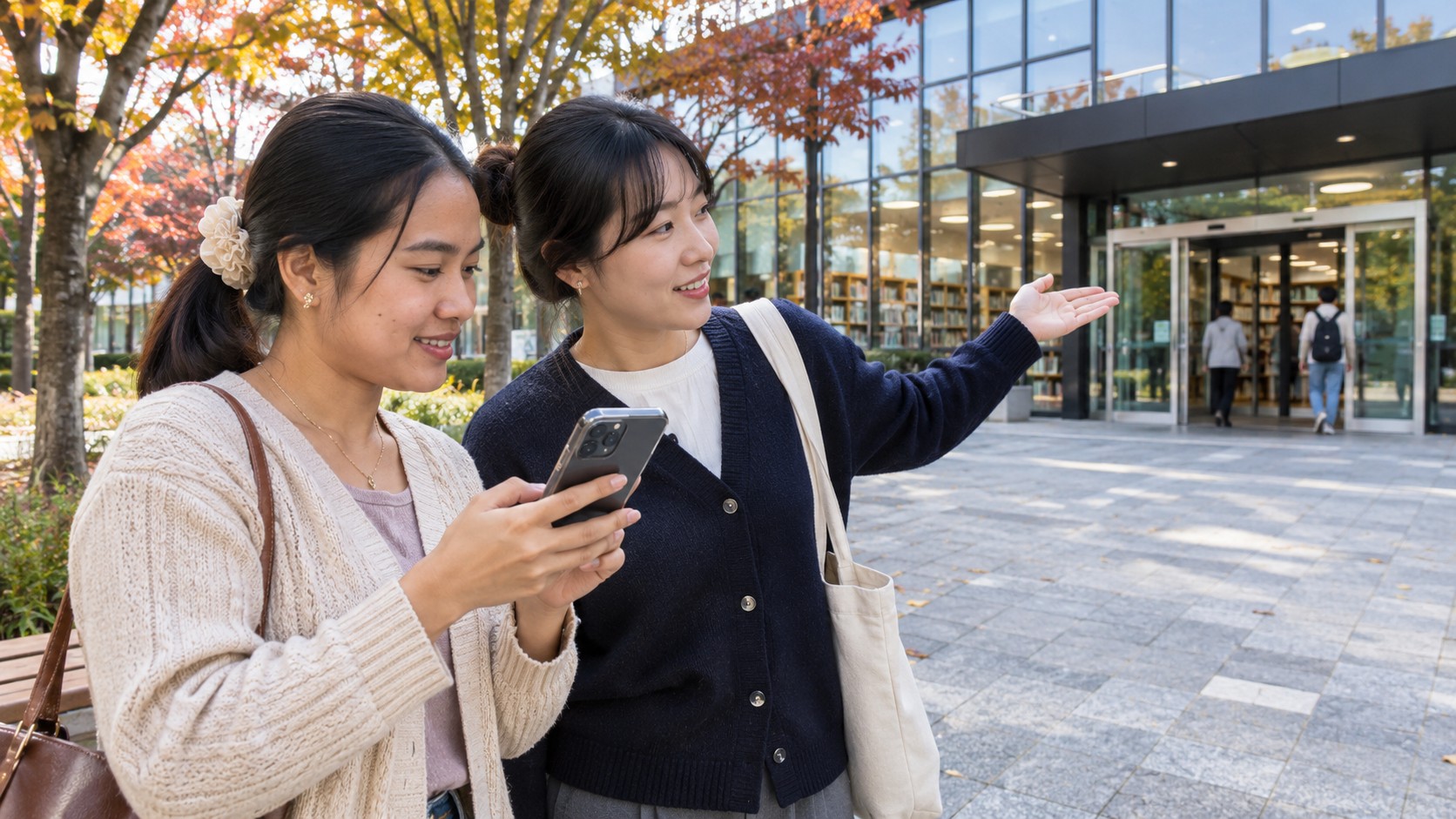
6. Explain a delay after the meeting is arranged
Korean: 죄송해요. 십 분 정도 늦을 것 같아요.
Thai meaning: ขอโทษครับ/ค่ะ น่าจะไปถึงช้าประมาณสิบนาที
Reading guide: Joe-song-hae-yo. Sip bun jeong-do neu-jeul kkeot ga-ta-yo.
Use this when the meeting is already confirmed but you expect a delay while travelling. Do not only say that you will be late; explain roughly how late. Give an estimated arrival time if you can, and contact the person again if that estimate changes.
Short dialogue
You: 죄송해요. 십 분 정도 늦을 것 같아요.
Your line in Thai: ขอโทษครับ/ค่ะ น่าจะไปถึงช้าประมาณสิบนาที
Other person: 도착하면 연락해 주세요.
Their line in Thai: เมื่อถึงแล้ว ติดต่อมานะครับ/คะ
This is an estimate, not a guarantee that the delay will be exactly that long. If you do not yet know when you will arrive, say that you will check and let the person know. If they cannot wait, agree on another time to meet.
Practise using the expressions in a real sequence
For your first practice, read the examples aloud in this order: request a change, suggest a new time, ask about the place, and confirm everything. Next, replace the time and place with your own details. Finally, look only at the Thai meanings, say the Korean, and then check the original. Aim to complete a message you can actually send rather than memorising a long passage.
Final check before sending your message
- Are the date and the morning or afternoon clear?
- Has the other person accepted the new time?
- Have you confirmed the building, entrance, and whether to meet inside or outside?
- Do you know how to contact the person if you are delayed?
Related reading and reference material
If you are taking a bus to the meeting, see Lesson 16: checking which way a bus is going
Basic word meanings and pronunciations were checked in the National Institute of Korean Language's Korean Basic Dictionary. The dialogues above are original learning examples for everyday meetings. References checked: 2026-11-08.
Official reference: Meaning and pronunciation of the Korean word for an arrangement or promise
Official reference: Meaning and pronunciation of the Korean word for being late
A message for when only the meeting time changes
Let’s change just the time to [new time]. We’re still meeting at [same place and exit], right?