
“내일 오전 여덟 시 반까지 오세요.”
“พรุ่งนี้ให้มาถึงไม่เกินแปดโมงครึ่งตอนเช้า”
Can you tell when you need to arrive? “오전 여덟 시 반” means 8:30 AM. If you hear only “여덟 시 반” and are unsure whether it means morning or evening, ask again.
At work in Korea, you may hear arrival times, lunch breaks and restart times in Korean. Even when you understand the numbers, missing “부터” (from), “까지” (by/until) or “동안” (for a duration) can change your understanding of the schedule.
This lesson introduces 8 expressions for checking your daily schedule. Each Korean sentence is followed by its Thai meaning. Check the meaning, then read the Korean sentence aloud.
The conversations and times below are learning examples. They are not working-hour or break-time rules for every workplace. Check your own employment contract and workplace instructions for your actual schedule.

1. 내일 몇 시까지 오면 돼요?
Korean: 내일 몇 시까지 오면 돼요?
Thai meaning: พรุ่งนี้ต้องมาถึงไม่เกินกี่โมง
Use this to ask the latest time you should arrive at work tomorrow. It is useful before your first day or when checking the next day’s schedule.
Short conversation — example situation
Worker: 내일 몇 시까지 오면 돼요?
พรุ่งนี้ต้องมาถึงไม่เกินกี่โมง
Supervisor: 오전 여덟 시까지 오시면 돼요.
มาถึงไม่เกินแปดโมงเช้า
Worker: 네, 오전 여덟 시까지 도착할게요.
ได้เลย จะมาถึงไม่เกินแปดโมงเช้า
“여덟 시까지” means no later than eight o’clock. Distinguish the time you leave your accommodation from the time you need to arrive at work. If you also need to check the location, use the following sentence.
Korean: 어디로 가면 돼요?
Thai meaning: ต้องไปที่ไหน
2. 일을 시작하는 시간은 몇 시예요?
Korean: 일을 시작하는 시간은 몇 시예요?
Thai meaning: เริ่มงานกี่โมง
This asks what time the work itself starts. Use it when you know when to arrive but are unsure when the task begins.
Short conversation — example situation
Worker: 일을 시작하는 시간은 몇 시예요?
เริ่มงานกี่โมง
Supervisor: 오전 여덟 시 십 분부터 시작해요.
เริ่มงานตอนแปดโมงสิบนาทีในตอนเช้า
Worker: 오전 여덟 시 십 분부터요?
เริ่มตอนแปดโมงสิบนาทีในตอนเช้าใช่ไหม
“몇 시까지 오세요” gives an arrival deadline, while “몇 시부터 시작해요” gives a start time. Check each time separately.
Korean: 오전 여덟 시까지 오세요.
Thai meaning: ให้มาถึงไม่เกินแปดโมงเช้า
Korean: 오전 여덟 시부터 시작해요.
Thai meaning: เริ่มตั้งแต่แปดโมงเช้า
3. 점심시간은 몇 시부터 몇 시까지예요?
Korean: 점심시간은 몇 시부터 몇 시까지예요?
Thai meaning: เวลาพักกลางวันเริ่มกี่โมงถึงกี่โมง
This asks when the lunch break starts and ends. You can also use it if you heard the start time but missed the end time.
Short conversation — example situation
Worker: 점심시간은 몇 시부터 몇 시까지예요?
เวลาพักกลางวันเริ่มกี่โมงถึงกี่โมง
Supervisor: 낮 열두 시부터 오후 한 시까지예요.
ตั้งแต่เที่ยงถึงบ่ายโมง
Worker: 오후 한 시에 다시 시작해요?
เริ่มงานอีกครั้งตอนบ่ายโมงใช่ไหม
Hearing only “점심은 열두 시예요” (lunch is at twelve) does not tell you when the break ends. Also ask when you should start working again after eating.
4. 쉬는 시간은 언제예요?
Korean: 쉬는 시간은 언제예요?
Thai meaning: พักตอนไหน
Use this to ask when you have a break during work. When you hear the daily schedule, check this along with the lunch break.
Short conversation — example situation
Worker: 오후에 쉬는 시간은 언제예요?
ช่วงบ่ายพักตอนไหน
Supervisor: 오후 세 시예요.
ตอนบ่ายสามโมง
Worker: 오후 세 시부터 쉬는 거예요?
เริ่มพักตอนบ่ายสามโมงใช่ไหม
“쉬는 시간” means a break, and “쉬는 날” means a day off. Make clear whether you are asking about a short break today or a day when you do not work.
Korean: 쉬는 시간
Thai meaning: เวลาพัก
Korean: 쉬는 날
Thai meaning: วันหยุด
5. 몇 시에 다시 시작해요?
Korean: 몇 시에 다시 시작해요?
Thai meaning: เริ่มงานอีกครั้งกี่โมง
Use this to check when to start working again after a break or meal. It also helps if you missed the time the break began.
Short conversation — an example in which the break begins at 3 PM
Supervisor: 지금부터 십 분 동안 쉬세요.
พักสิบนาทีตั้งแต่ตอนนี้
Worker: 몇 시에 다시 시작해요?
เริ่มงานอีกครั้งกี่โมง
Supervisor: 오후 세 시 십 분에 다시 시작해요.
เริ่มงานอีกครั้งตอนบ่ายสามโมงสิบนาที
“십 분 동안” describes a duration of ten minutes; “세 시 십 분” is a clock time, ten past three. If you do not know when the ten-minute break began, ask for the restart time.
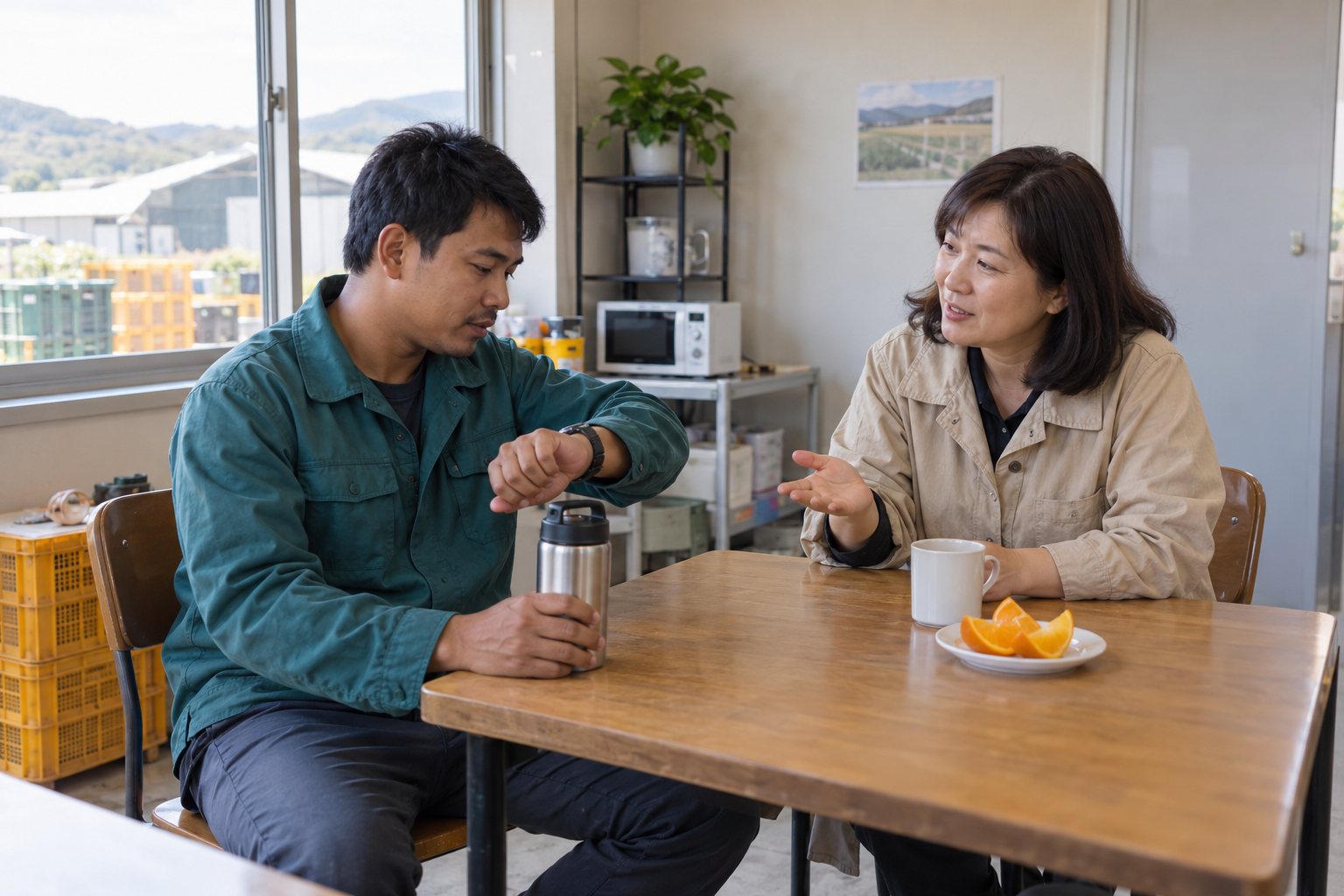
6. 오늘은 몇 시에 일이 끝나요?
Korean: 오늘은 몇 시에 일이 끝나요?
Thai meaning: วันนี้เลิกงานกี่โมง
Use this to ask when work finishes today. It can help you plan your bus journey or other activities after work.
Short conversation — example situation
Worker: 오늘은 몇 시에 일이 끝나요?
วันนี้เลิกงานกี่โมง
Supervisor: 오늘은 오후 다섯 시에 끝나요.
วันนี้เลิกงานตอนห้าโมงเย็น
Worker: 오후 다섯 시요? 네, 알겠습니다.
ห้าโมงเย็นใช่ไหม ได้เลย เข้าใจแล้ว
Asking when work ends is different from asking whether you may leave now. To check whether you can finish and go home now, use the following expression.
Korean: 지금 퇴근해도 돼요?
Thai meaning: ตอนนี้เลิกงานกลับได้ไหม
7. 내일도 같은 시간에 오면 돼요?
Korean: 내일도 같은 시간에 오면 돼요?
Thai meaning: พรุ่งนี้มาเวลาเดิมได้ไหม
Use this to check whether you should arrive at the same time tomorrow. It is useful to ask before leaving work.
Short conversation — example situation
Worker: 내일도 같은 시간에 오면 돼요?
พรุ่งนี้มาเวลาเดิมได้ไหม
Supervisor: 내일은 오전 여덟 시 반까지 오세요.
พรุ่งนี้ให้มาถึงไม่เกินแปดโมงครึ่งตอนเช้า
Worker: 내일은 오전 여덟 시 삼십 분까지요?
พรุ่งนี้ต้องมาถึงไม่เกินแปดโมงสามสิบนาทีตอนเช้าใช่ไหม
When telling the time, “반” means 30 minutes. If the new time differs from today’s schedule, write down both the date and time.
Korean: 오전 여덟 시 반 = 오전 여덟 시 삼십 분
Thai meaning: แปดโมงครึ่งตอนเช้า = 08:30 น.
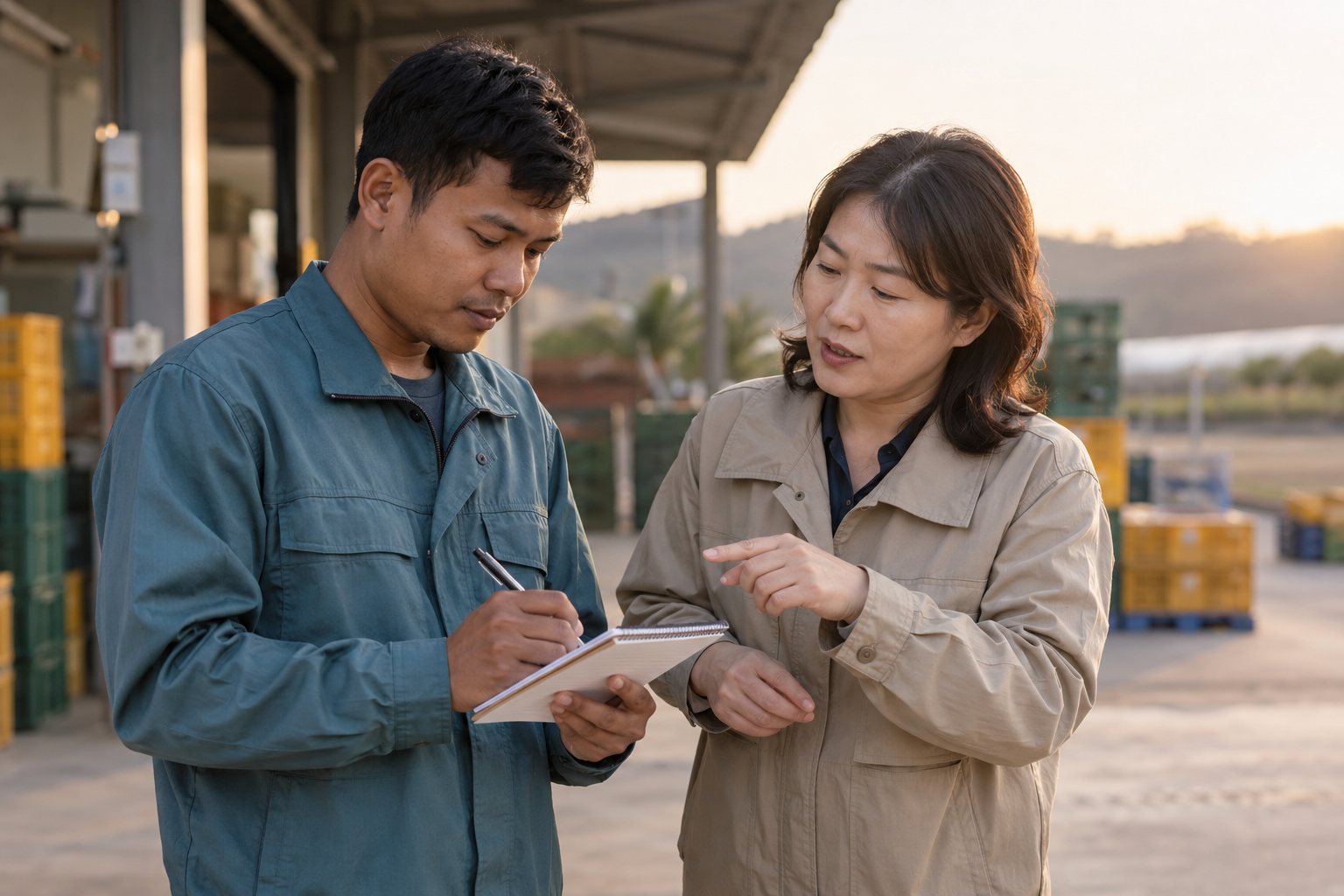
8. 십 분 정도 늦을 것 같아요
Korean: 십 분 정도 늦을 것 같아요.
Thai meaning: คิดว่าจะไปถึงช้าประมาณสิบนาที
Use this when you expect to arrive about ten minutes late. If you know how late you will be, include that information.
Short conversation — example situation
Worker: 죄송합니다. 버스가 늦어서 십 분 정도 늦을 것 같아요.
ขอโทษด้วย รถโดยสารมาช้า คิดว่าจะไปถึงช้าประมาณสิบนาที
Supervisor: 알겠습니다. 도착하면 알려 주세요.
เข้าใจแล้ว ถ้ามาถึงแล้วช่วยบอกด้วย
Worker: 네, 도착하면 연락드릴게요.
ได้เลย ถ้าไปถึงแล้วจะติดต่อไป
“늦을 것 같아요” means you expect to be late. After arriving late, you can use the following apology instead.
Korean: 늦어서 죄송합니다.
Thai meaning: ขอโทษที่มาสาย
If you expect to be late, contact the person in charge when it is safe to do so. If you do not yet know your arrival time, you do not need to invent one.
Korean: 몇 시에 도착할지 아직 모르겠어요.
Thai meaning: ยังไม่รู้ว่าจะไปถึงกี่โมง
Time expressions that can be confusing
Check whether the time is AM or PM
“일곱 시” alone does not always make clear whether it means AM or PM. Ask again using both possible times.
Korean: 오전 일곱 시예요, 오후 일곱 시예요?
Thai meaning: เจ็ดโมงเช้าหรือหนึ่งทุ่ม
Writing the time in numbers can make the difference clearer.
오전 일곱 시 — เจ็ดโมงเช้า — 07:00
오전 여덟 시 반 — แปดโมงครึ่งตอนเช้า — 08:30
오후 한 시 반 — บ่ายโมงครึ่ง — 13:30
오후 다섯 시 — ห้าโมงเย็น — 17:00
오후 일곱 시 — หนึ่งทุ่ม — 19:00
Listen for “부터”, “까지” and “동안”
Korean: 오후 세 시부터 쉬세요.
Thai meaning: เริ่มพักตั้งแต่บ่ายสามโมง
Meaning: the time when the break begins.
Korean: 오후 세 시 십 분까지 쉬세요.
Thai meaning: พักได้ถึงบ่ายสามโมงสิบนาที
Meaning: the time when the break ends.
Korean: 십 분 동안 쉬세요.
Thai meaning: พักเป็นเวลาสิบนาที
Meaning: how long the break lasts.
These three sentences have different meanings. Listen to the words after the numbers as well. If you are unsure, confirm when to start again.
Practise with your own situation
The situations below are learning examples. Try answering in Korean before checking the sample answer. You can practise again using different times.
Exercise 1
The person in charge told you to arrive no later than half past eight tomorrow. You also want to check that they mean the morning.
Sample answer: 내일 오전 여덟 시 삼십 분까지 오면 돼요?
Thai meaning: พรุ่งนี้ต้องมาถึงไม่เกินแปดโมงสามสิบนาทีตอนเช้าใช่ไหม
Exercise 2
You heard that the break lasts ten minutes, but missed when it began.
Sample answer: 몇 시에 다시 시작해요?
Thai meaning: เริ่มงานอีกครั้งกี่โมง
Exercise 3
Your bus is running late, and you expect to arrive about ten minutes after the agreed time.
Sample answer: 죄송합니다. 버스가 늦어서 십 분 정도 늦을 것 같아요.
Thai meaning: ขอโทษด้วย รถโดยสารมาช้า คิดว่าจะไปถึงช้าประมาณสิบนาที
Three sentences to remember today
내일 몇 시까지 오면 돼요?
พรุ่งนี้ต้องมาถึงไม่เกินกี่โมง
몇 시에 다시 시작해요?
เริ่มงานอีกครั้งกี่โมง
오늘은 몇 시에 일이 끝나요?
วันนี้เลิกงานกี่โมง
After hearing the answer, confirm it once more using the date and time. In your phone or notebook, record the date, arrival location, arrival time and work start time separately so you can check them later.
Related reading
Lesson 1 teaches how to ask someone to repeat an explanation you missed.
Korean for Daily Life 1 | Asking again when you do not understand work instructions
https://lkcommunity.com/?article=한국생활-언어-1편-작업-설명을-이해하지-못했을-때-다시-묻는-한국어-d970e8fb
Looking up more words
You can look up unfamiliar Korean words in the National Institute of Korean Language’s Korean–Thai Learners’ Dictionary.[1]
The dialogues, exercises and Thai meanings in this article were created for learning; they are not copied examples from the dictionary.
Learning resource
[1] National Institute of Korean Language, Korean–Thai Learners’ Dictionary
https://krdict.korean.go.kr/tha/mainAction
Source checked: 22 September 2026